This is Umut Newbury's page:
| |
|
|
|
|
|
|
|
 The red and white logo of Coca-Cola is one of a few international brands recognized so instantly and globally. If there is life outside of Earth, Coca-Cola would be one of the brands that would be recognized universally, too, because even Martians would have seen the Coke Santa, which debuted in The Saturday Evening Post before World War II. It’s a ubiquitous product that has made itself a lifestyle choice of billions of people. The red and white logo of Coca-Cola is one of a few international brands recognized so instantly and globally. If there is life outside of Earth, Coca-Cola would be one of the brands that would be recognized universally, too, because even Martians would have seen the Coke Santa, which debuted in The Saturday Evening Post before World War II. It’s a ubiquitous product that has made itself a lifestyle choice of billions of people.
The Coca-Cola Company didn’t achieve this by creating a product so essential to human life; instead it managed to win people’s hearts and minds by having an extremely positive and successful marketing campaign. People all over the world associate Coke products with the pursuit of happiness and an improved quality of life. From its 1963 slogan, “Things Go Better with Coke,†to the 1979 “Have a Coke and a Smile,†to the 2001 “Life Tastes Good;†its jovial Santas making an appearance each year and even the World Cup mascot every four years on the collectible cans, Coca-Cola has worked hard to make us happy while quenching our thirst with the magically fizzy combination of water and sugar (or high fructose corn) syrup. (Full disclosure: This reviewer began drinking Coca-Cola at the age of 4 and for the next quarter century or so was one such content customer, turning to Coke products for refreshment and pleasure with a daily consumption of multiple glass bottles at first, then cans and then the 20-ounce plastic bottles before finally kicking the habit in 2004.)
For those current happy-go-lucky Coca-Cola fans out there, directors German Gutierrez and Carmen Garcia have some grim news to deliver in their new documentary, The Coca-Cola Case. Their film takes that pleasant image of Santa Claus decked out in red and white and replaces it with the blood of international bottling plant workers and the pale white faces of corpses. Read the rest of this entry »
|
|
|
|
| |
|
|
|
|
|
|
|
By Umut Newbury
June 15, 2009
 Last week, we saw an image of an American president that has been foreign to us for a little while. In Cairo, tens of thousands of Muslims cheered for President Barack Obama, as he spoke of a different world with a different United States leading it. He quoted from the three major Western religious texts and brought Egyptians to their feet with applause. As President Obama works on his second 100 days in the White House, it is a good time to take a look back and reflect on his campaign that brought him there. Last week, we saw an image of an American president that has been foreign to us for a little while. In Cairo, tens of thousands of Muslims cheered for President Barack Obama, as he spoke of a different world with a different United States leading it. He quoted from the three major Western religious texts and brought Egyptians to their feet with applause. As President Obama works on his second 100 days in the White House, it is a good time to take a look back and reflect on his campaign that brought him there.
Danny Schechter’s new documentary Barack Obama: People’s President, is a refreshing take on Obama’s campaign to the presidency. Rather than cutting and pasting coverage of talking heads telling us how Obama became the president, Schechter tries an old technique known to print journalists of yesteryear: showing it. His film opens with the famous “Yes We Can†video created by will.i.am and continues with 90 minutes of very diverse footage of the grassroots campaign that got Obama elected.
Anyone who was an official volunteer for the Obama campaign, or an unofficial volunteer (disclosure here, this reviewer was one of them) who lobbied friends, relatives, neighbors to register to vote, donate money, vote and pass on the word will enjoy seeing this big picture view of the campaign. As for those who voted and volunteered for other candidates, they would be mistaken to dismiss this film as a victory dance. People’s President lays out the steps of the Obama campaign’s success for anyone willing to learn how it was done.
The theme of Schechter’s film is the people behind the people’s candidate. Schechter’s premise is simple enough: Obama’s success lies in his campaign’s innovative use of the Internet and other new technologies, which helped lure the youth vote and reach out to many other hard-to-get constituencies. The film has footage of self-described Obama Camps across the nation, as well as an array of creativity the campaign fostered on the Internet, from will.i.am to Obama Girl and to lesser-known clips such as the “Irish Obama†and “How Obama won the KKK.†Schechter also has some experts analyzing all of this, such as NBC’s Jonathan Alter and MoveOn.org’s David Fenton. Hendrik Hertzberg of The New Yorker magazine recollects his meeting with Obama as the moment he realized that the candidate was exactly how he portrayed himself to the masses, “thoughtful, calm, disciplined, well-organized, human and strong.â€
Any campaign, Schechter argues, needs money and people. The Obama campaign got both in unforeseen amounts. Fenton says Obama won because the online tactics “broke the grip of large donors on the Democratic Party.†People like Scott Cohen describe how they felt when they heard Obama’s speech in Springfield. “I wrote the largest check of my life, for $2,300, and talked others to do so.†Cohen later had the idea to create the “An Obama Minute†video, where he asked people to give as much as they can. The first time the video aired, it raised more than $200,000.
The other strength of the Obama campaign, People’s President shows, was the superiority of its operation. The Chicago headquarters had the slogan, “No Drama with Obama.†Unlike other campaigns, there was no internal fighting, no unauthorized leaks or embarrassments. They had a tight, smooth running organization, with a simple message, “Change.†As Jonathan Alter points out, while Hillary Clinton played with different messages, the Obama campaign stuck to its original message and added a simple slogan, “Yes We Can.†Read the rest of this entry »
|
|
|
|
| |
|
|
|
|
|
|
|
By Umut NewburyÂ
February 23, 2009
Â
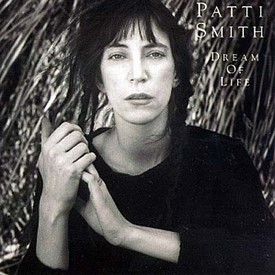 “Life isn’t some vertical or horizontal line; it isn’t neat,†declares Patti Smith early on during Dream of Life. This is true for both the subject and the style of Steven Sebring’s documentary. “Life isn’t some vertical or horizontal line; it isn’t neat,†declares Patti Smith early on during Dream of Life. This is true for both the subject and the style of Steven Sebring’s documentary.Â
Most biographical documentaries follow a linear pattern. But when a filmmaker spends 11 years (or a quarter of his life, as Sebring puts it in the booklet of the DVD), it is not possible to fit that immensity of footage into a traditional biopic format. Sebring’s Patti Smith: Dream of Life is epic, poetic and artistic, but definitely not neat.Â
The film opens like a punk rock song – in less than three minutes Smith summarizes her entire life. We learn that she was born in Chicago, got a job at a factory at age 16, moved to New York and met Robert Mapplethorpe, lived in Chelsea Hotel, married Fred Smith, had two kids. In 1989 Mapplethorpe died followed by Fred and her brother Todd’s deaths in 1994. Just exactly how a regular working-class teenager from New Jersey moves to New York and meets someone like Mapplethorpe and lives in Chelsea Hotel isn’t explained – perhaps it isn’t important, perhaps it doesn’t matter. Â
Smith’s narrative of her life during Sebring’s documentary is definitely selective. About her move to New York, all she says is that she knew there was not a chance “to be destroyed or to be created in New Jersey,†and that’s why she moved. Her descriptions of early experiences in New York are Whitmanesque. She speaks of the smells and sounds and the sky, a classic case of a young artist taking in it all in, hoping that someday, she, too, will be a part of the scenery that other young hungry minds will want to absorb.Â
Dream of Life really centers on Smith’s one quote: “Life is an adventure of our own design intersected by fate and a series of lucky and unlucky accidents.†We get a good glimpse at exactly how lucky she was. Aside from being close to Mapplethorpe, Smith also mentions nonchalantly that Sam Shepard (playwright, actor) happened to gift a 1939 Gibson to her. When she lived at the Chelsea Hotel, she would invite musicians to come see this guitar, they would play it and “that’s how I got it tuned.†The 1970s are definitely lucky years for Smith, she goes on to meet William S. Burroughs and flirt with him, even though he had to kindly remind her: “My dear, I am a homosexual.â€Â
Sebring then takes us to Smith’s childhood home and parents. Smith’s parents are the most adorable working-class parents anyone can have in New Jersey. She couldn’t have come from a more cookie-cutter home; complete with a mom obsessed with cow figurines and a softhearted dad who used to feed squirrels in his backyard. He says he stopped the feeding a while back, and adds wistfully: “They have to fend for themselves now.†One could only imagine their reaction to the likes of Mapplethorpe and Burroughs, though they seem to have accepted Patti for who she is. Smith recalls a time when she performed for the two of them before a show and says, “Only for you mom, would I do a medley.â€Â
Here is when a documentary-maker really benefits from following a subject around for more than a decade. By far, the best footage of the film is when Smith is talking about losing her brother. She explains the strange feeling one gets after losing a loved one:  “When he died, my heart became full of him. I became a better person, more optimistic.â€Â
There are many candid moments like that throughout the film, such as when Smith’s son Jackson is talking about the birthday helmet he received and just exactly what he thinks about birthdays in general. Or the part where Smith is trying to unlock the Persian urn that holds some of Mapplethorpe’s ashes. She says she got some of his ashes, so she “can travel with him.â€Â
Smith is lucky for having to meet and be close to so many special, talented people like Mapplethorpe, Burroughs, Allen Ginsberg, Gregory Corso and Michael Stipe. The unlucky part, of course, comes from seeing most of those people die. There is footage of the wake of Ginsberg and her walking around Corso’s grave. She puts that pain plainly earlier in the film when she makes the remark about “the time when all my friends were alive.â€Â
Sebring, on the whole, stays extremely loyal to Smith throughout Dream of Life. This is a biographical documentary about Smith as told by Smith. There are no interviews with friends and family when she is not present. There is no narrator but Smith. Sebring’s film is not a piece of investigative journalism; it is an essay, a poem, a painting Smith created about herself that Sebring captured. Smith doesn’t talk much about her husband Fred, or the details of her relationship to others or her musical career. Â
Dream of Life is a haiku about Smith. The bad news is if one does not get the haiku, then she won’t get Smith. The good news is, there is plenty of material yet to be covered about Smith, so young filmmakers can go and retrace Smith’s steps in New Jersey, New York and beyond. So, this isn’t the definitive film about Smith, just a very beautiful and warm meditation on her…�
—–
Patti Smith: Dream of Life
2008 Palm Pictures
Directed by Steven Sebring
109 minutes
|
|
|
|
| |
|
|
|
|
|
|
|
Â
By Umut Newbury
December 9, 2008Â
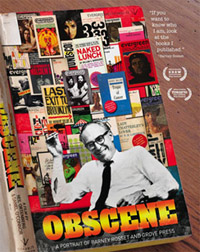 This holiday season, books like “Lady Chatterley’s Lover,†“Tropic of Cancer,†“Naked Lunch†may not be on too many gift lists, but they should be. This holiday season, books like “Lady Chatterley’s Lover,†“Tropic of Cancer,†“Naked Lunch†may not be on too many gift lists, but they should be.Â
While the trials and tribulations of comedians George Carlin and Lenny Bruce with obscenity are well publicized and known about, the story of one American publisher and the trouble he went through to distribute the three titles mentioned above are almost unknown.Â
Neil Ortenberg and Daniel O’Connor put the much-deserved spotlight on Barney Rosset, the founder of Grove Press and Evergreen Review, in their debut documentary Obscene. Â
Rosset is a Chicago native, born to Irish-Catholic and Jewish parents. Though he did serve in World War II, that’s where the 86-year-old’s similarities end with his peers in the Greatest Generation. Rosset went to radical progressive schools in Chicago and started his subversive activities in high school. He circulated a petition for John Dillinger to be pardoned and ran a newspaper, which eventually became the Anti-Everything Newspaper. Rosset’s first love was film, and through his banker father’s good connections, he managed to serve as an army cinematographer along with the likes of Frank Capra and John Hughes during WWII. His first project after the service was Strange Victory, a feature film about the problem of racism in the U.S.Â
Rosset’s foray into publishing was almost accidental. His first wife, Joan Mitchell, after the couple broke up, told him about a publishing house that was abandoned after three books. In Obscene, Rosset puts it rather nonchalantly, “Somehow I acquired it.†Things that occurred afterwards, however, hardly seem random. Â
His first great literary find was Samuel Beckett’s “Waiting for Godot,†back when it was a small play in Paris. In 1954, Rosset went to meet Beckett and managed to get the American publishing rights of the play for a ridiculous sum ($100 or $150), but told friends, “you mark my words, someday Beckett will be huge.â€Â
Rosset then started the Evergreen Review, the radical literary magazine, which was unlike all other magazines at the time. One colleague tells Obscene, “We were rebels; looking for things nobody else would publish.†When City Lights owner Lawrence Ferlinghetti got arrested and charged with obscenity for publishing Allen Ginsberg’s “Howl,†Rosset published the poem in Evergreen as an act of solidarity. For many people, this was the first time they had a chance to read the epic poem, since all the book copies were impounded.  The judge ultimately found “Howl,†not obscene and exonerated Ferlinghetti. Â
Rosset’s legal battle against obscenity began with D.H. Lawrence’s “Lady Chatterley’s Lover.†When published in 1928, it created furor in the U.S. In 1959, Rosset chose that as his first fight against censorship. “My god, people won’t publish a book like ‘Lady Chatterley’s Lover,’†he says in Obscene, “which made me vomit. I had guts and I would fight.†All the literary experts of the time got behind Grove Press and Rosset, leading the court to rule that the book was not obscene and “may be out in mail.â€Â
Next, Rosset tackled Henry Miller’s “Tropic of Cancer.†Published in 1934 in Paris, the book was banned in the U.S. and literally made it copy by copy across the Atlantic in people’s luggage. In Obscene, Erica Jong brilliantly summarizes the trouble with “Tropic of Cancerâ€: “If just having a word like ‘cunt’ is going to throw you off the track, you’ll never know what Miller’s all about.†The court seemed less friendly toward Miller and “Tropic of Cancer.†As one witness to the case puts it, “When you went in to testify for ‘Lady Chatterley,’ you were treated with respect. With Miller, you were treated as a member of a shit group.†Luckily for Rosset, the battle culminated in a lawsuit in his hometown Chicago and the presiding judge just happened to be a close friend of his late father. Rosset 2, Censorship 0. Â
After those two legal victories, Rosset felt it was time to start distributing William Burroughs’ “Naked Lunch,†which already had been printed, awaiting the result of the “Tropic of Cancer†lawsuit. The lawyers, Obscene informs us, were really afraid of this particular battle. Through the battle for “Tropic of Cancer,†Rosset managed to get the public opinion on “Lady Chatterley†to change from “wicked, perverse,†to a “fine book.†Through the fight for “Naked Lunch,†“Tropic of Cancer†was elevated from “a corrupt mess,†to “a great classic.†Still, “Naked Lunch†managed to prevail in the courts as well. Rosset, quoted early in the film as saying, “I feel personally there hasn’t been a word written or uttered that shouldn’t be published,†succeeded in getting a lot of judges to agree with that sentiment.Â
What’s most amazing about Rosset, though, is not just his incredible struggle for First Amendment rights, but also his ability to get a really respectable list of authors under the umbrella of Grove Press. Just like he predicted, Beckett won international acclaim and the Nobel Prize in 1969. Rosset published other Nobel winners, as well, including Kenzaburo Oe, Pablo Neruda and Octavia Paz.Â
Rosset’s story is a classic American story, the tale of a wild-eyed man with a lot of guts and some good luck and resources through family to fight the right battle. Obscene is an engaging biography with lots of detail and a star-studded interviewee list. There is the always-charming John Waters convincingly claiming that many in the arts and media “are benefiting from freedoms that we have because of what Barney Rosset did†and an aging Jim Carroll talking about his drug days with William Burroughs. Gore Vidal, Amiri Baraka and Ray Manzarek are also among the famous that chip in with their perspectives on Rosset’s contributions to freedom of expression.Â
As thoroughly as directors Ortenberg and O’Connor walk us through Rosset’s early life and three major legal battles, they unfortunately wrap up the later years of Grove Press and Evergreen Review rather quickly and haphazardly. Obscene glosses over the incident when a bunch of feminists attempt to unionize Grove Press. Rosset dismisses them as “FBI agents†but blames the financial fall of the company on the mutiny. At the end of the film, we find out Rosset sold acres of land he owned in the Hamptons to keep the court cases going and that he went broke, sold the company then got fired. The details are murky and confusing. Surely, this wasn’t one of Rosset’s favorite parts of his life story, but it deserved a little more attention.Â
Nevertheless, for those of us in the arts and media, Obscene is a wonderful history lesson. The notion of “Lady Chatterley’s Lover,†“Tropic of Cancer†or “Naked Lunch†being banned in the country that made a big enough deal about freedom of expression to make it its very first amendment is itself obscene. Rosset probably won’t get a presidential medal of honor for protecting First Amendment rights, but this film is the next best thing, paying respect to a true American icon that should be a household name. Â
—–
Obscene: A Portrait of Barney Rosset and Grover Press
Directed by Neil Ortenberg and Daniel O’Connor
2008 Arthouse Films
Color, 97 minutes
|
|
|
|
| |
|
|
|
|
|
|
|
By Umut Newbury
September 18, 2008
More than 20,000 Americans will die in 2008. The cause of their death will not be combat, traffic accidents or terrorism. They will die because they do not have health insurance.

In the 21st century, in the world’s richest nation, how that statistic doesn’t shock, deeply depress or simply upset Americans, is hard to comprehend. When Michael Moore released Sicko in 2007, the assumption about his film was that it would focus on uninsured Americans. Instead, Moore chose as his subjects those with supposedly “good†health coverage. Though he exposed how even the covered fall through the cracks tragically, Moore’s film didn’t have the impact it deserved. The mainstream media (the likes of Dr. Sanjay Gupta on CNN) decided the “fact-check†Sicko and argued that health care in Cuba wasn’t that much better than in the U.S. They emphasized how long the waiting lines in Canada were. So, the vast majority of Americans were persuaded once again that, even if their health insurance wasn’t saving their lives when they needed it, darn it, it was still better than that of foreigners.
What about the uninsured then? Two-time Academy Award nominee director Roger Weisberg takes us into the deep, dark underbelly of the life of 47 million Americans who do not have health insurance in his new film Critical Condition and it isn’t pretty. Weisberg’s brilliantly somber documentary is hard to watch. As well it should be, for anyone who has a heart or a soul. He takes us on a very personal journey of four patients and their families. These are not welfare-sucking, crack-addicted deadbeats the mainstream media would have us believe as the sole victims of lack of health insurance. All of them are working, tax-paying, law-abiding citizens. In fact, as Weisberg points out, the overwhelming majority (80 percent) of those without health insurance are working-class Americans. Let’s repeat that (if only for Lou Dobbs): Not immigrants, not illegal immigrants, but millions of Americans who work for a living have no health insurance.
Joe Stornaiuolo is a doorman from Bethlehem, Pennsylvania. He is diabetic and has a liver disease, though he never drank. When he was diagnosed with the illness, his employer decided he could no longer do his job. When Stornaiuolo lost his job, he lost his health insurance, too. When he couldn’t afford his medicine, he started skipping doses and got sicker and sicker.
Hector Cardenas is a warehouse manager in Los Angeles. His diabetes caused a foot infection that spiraled into gangrene. He had insurance through his job, but taking care of the gangrene was taking too long and eating up all his sick time. His doctor told him, “It’ll take four to five months to save your foot, but if you want to go back to work, we’ll have to cut your foot off.†Hector told his doctor to cut his foot off and still lost his job and his insurance.
Karen Dove, of Austin, Texas, and her husband Ronnie couldn’t afford health insurance. For months, she had abdomen pains. Doctors kept turning her away because she didn’t have coverage. Finally, she contacted the Cancer Society and got a call from a doctor’s office willing to see her. By the time she was diagnosed, her ovarian cancer was in Stage 3. “Most people with Stage 3 cancer will die,†said her doctor.
Carlos Benitez, a chef for a French restaurant in Los Angeles, has been living with chronic back pain and deformity of his spine for 15 years. He makes $45,000 a year, but decided several years ago to let go of his health insurance because he needed the extra money to raise his family. When he went to a free health clinic at the UCLA campus, he was told that he needed to go to a doctor immediately because the pain medication was making him bleed to death. He got a blood transfusion and escaped death, but no doctor in California would perform the surgery to fix his spine and end his pain, because he didn’t have the money.
Weisberg tells the stories of these families candidly. These are not political people trying to push a policy issue. Critical Condition reveals them as they are, regular, hard-working Americans with terrible health conditions, yet with very few options. Weisberg, though, has done his homework on the health care issue, and peppers the film with sharp statistics. When people like Carlos, Karen, Joe and Hector run out of options, they go into emergency rooms. Covering the bills of the uninsured like them, Weisberg tells us, increases the annual health insurance premiums of a family by $922 per year. He also points out that though the U.S. spends $2 trillion per year on health care, it still ranks 24th in life expectancy, 27th in infant mortality and that lack of health insurance is the sixth leading cause of death here.
With less than two months from the presidential election and just days before the first debate between the candidates, Critical Condition is timed perfectly. Weisberg’s film makes it painfully obvious that health care in the U.S. is no longer a problem — it is a crisis.
A new study published this week in the journal Health Affairs projects that Sen. John McCain’s health plan would cause as many as 20 million Americans to lose their health insurance through their employers in the next five years. Add that to the number of uninsured now, we might be looking at almost 60 million Americans without insurance —that makes one-fifth of the population without access to health care by 2013. In July, another study by the Urban Institute and Brookings Institution projected an initial rise in people with health coverage under McCain’s plan, but predicted the number would start to dwindle in a few years. The same study showed that Sen. Barack Obama’s plan would reduce the number of uninsured by 18 million in 2009 and by 34 million by 2018. Obama’s plan still falls short of universal health care coverage.
Critical Condition makes the viewer wonder why it is so forbidden to talk about single-payer, universal health care in this country. What are we so afraid of? What could be worse than 22,000 people dying every year? Surely, the two major presidential candidates will not have a chance to view this significant documentary before Election Day. But perhaps the mainstream media can take a look at it honestly, and make it a part of the debates. Or is it too much to ask to move beyond the critical issue of lipstick and take a look at what’s killing people and how to fix it?
—–
Critical Condition
Directed by Roger Weisberg
83 minutes plus extras
Docurama Films 2008
Premieres on Sept. 30, 2008 on PBS
|
|
|
|
| |
|
|
|
|
|
|
|
By Umut Newbury
August 7, 2008
“To me it’s so simple that life should be lived on the edge of life. You have to exercise in rebellion, to refuse to taper yourself to rules, to refuse your own success, to refuse to repeat yourself to see every day, every year, every idea as a true challenge and then you are going to live your life on a tight rope.” -Philippe Petit
 Life, death, dreams and rebellion… The French have always been extraordinarily talented in defying the mainstream Western cultures’ accepted notions on these. The last time the French were truly successful at jarring our sense of what is good – life, what is evil – human mortality, was done through New Wave cinema with the likes of Jean Luc Godard and Francois Truffaut. Life, death, dreams and rebellion… The French have always been extraordinarily talented in defying the mainstream Western cultures’ accepted notions on these. The last time the French were truly successful at jarring our sense of what is good – life, what is evil – human mortality, was done through New Wave cinema with the likes of Jean Luc Godard and Francois Truffaut.
James Marsh’s new documentary, Man on Wire, combines the best of that era: Godard’s Breathless, and Truffaut’s 400 Blows, with a touch of Camus. For the post-911 world inhabitant, it is a foreign time, where breaking into buildings, i.e. the World Trade Center towers, and mocking death was an act of art, not an act of terrorism.
The subject of Marsh’s masterpiece, Philippe Petit, is not your typical Frenchman, just smoking cigarettes and drinking Bordeaux and cursing the meaninglessness of life at a sidewalk cafe. He is a reckless high-wire walker taunting death on a daily basis. His goal: To walk on a wire suspended between the North and South towers of the World Trade Centers shortly after they are built in 1974.
“My story is a fairy tale,†Petit begins rather innocuously. He was a little boy with a passion for climbing things, anything: “Why, I’ll let the psychiatrists to figure out the reasons. To escape things, to see things from a different perspective.†Well, the little French boy gets a toothache someday and is sitting in a dentist’s office looking at magazines. He sees a picture of these two towers (the French media cleverly juxtaposed the Eiffel Tower in front of them to show how magnanimous they would be when they were built) and is smitten instantly. He rips the picture out of the magazine and carries it with him: “Usually, when you have a dream, it’s there, tangible. The object of my dream doesn’t even exist yet.â€
The film doesn’t quite explain how Petit grows up to have the luxury of just walking on wires in his backyard and dreaming of scaling large, prominent buildings, and it really doesn’t have to. This story originates in France, after all, and we must start with a romance. Petit pursues a shy 20-year-old, Annie Allix, and she immediately becomes his number one fan and supporter of reckless acts. By 1971, Petit gets his first grandiose idea: To walk on a wire between the towers of the Notre Dame Cathedral. He sees it not as trespassing on the holy, rather describes himself as “a poet conquering beautiful stages.†The footage is simply breathtaking, even for those who have never been a fan of circus acts. There is a deep philosophical sense about Petit’s act. Somehow, it is not about the ridiculousness of a young man risking his life publicly. He is making a statement.
Two years later, in June of 1973, Petit, Allix and Petit’s other, nonsexual cohorts, repeat the act at the Sydney Harbour Bridge. Again, it is a magnificent scene. The whole bay of Sydney stretched out below a lunatic, while regular folks are communing to work, provides an immensely ironic perspective. When he gets arrested, Petit is still playing around, managing to swipe the watch of a Sydney policeman. The viewer would think this is a child who does not understand the consequences of his actions. But he does. “The fact that high-wire activity is framed by death is great,†Petit says. “You have to take it seriously.†With every potentially fatal act, Petit seems to be saying, “I understand life. I understand death in a way you will never know.â€
After the Notre Dame Cathedral and the Sydney Harbour Bridge, where does the high-wire walker take his act? Of course, he could have chosen any of a number of well-known European or Asian sites, however, this was all a means to an end – The World Trade Center towers. “The two towers galloping in my head, as I return to Paris, the towers were almost built,†Petit recalls. His girlfriend Allix admits to having limits to her undying support. “When he showed me the pictures, I was afraid. It’s inhuman to want to go up 450 meters in the air and walk. This was demonic, I wanted to say, ‘Stop.’†But she doesn’t. Neither do his buddies, Jean Louis Blandeau or Jean Francois Heckel. Heckel says about the Notre Dame project, “It was against the law, but not wicked or mean. It was wonderful.†So when approached about the World Trade Center project, Heckel is in. So is Blandeau, after receiving a postcard from New York. He looks at the towers on the front of the card, with a line drawn between them. “I thought, of course, that’s why they are there.â€
Blandeau is the voice of reason in the group, immediately realizing that there is no way to accomplish Petit’s crazy dream legally. No one is going to authorize such a wildly risky, childish dream. Once again, this will be a covert operation. Petit’s small group of outlaws soon grow, with an Australian, a couple of stoner Americans, and even an inside man from the WTC. To some, it is “a fun adventure,†others admit that they have been drawn to things, “that are not totally legal.â€
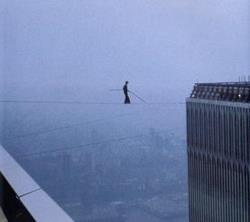
The team travels back and forth between New York and France. They spy on the World Trade Center towers, disguise themselves to get information, set up a “training camp†in a meadow in France. By all modern classifications, they must be terrorists. The day of the act, affectionately nicknamed “Le Coup†by Petit, they sneak in the buildings with fake IDs. Everybody is terrified, everyone is convinced they will get busted and end up in jail or deported. But after more than 12 hours, in the early morning hours of Aug. 7, 1974, Petit manages to get on his wire between WTC North and South towers. He walks back and forth for 45 minutes, making the crossing eight times. Sgt. Charles Daniels, one of the two Port Authority police officers on the scene describes him as a “tight rope dancer because you couldn’t call him a walker.†Petit keeps walking back and forth smiling at the police, taunting them, only agreeing to step off after being told that he will be plucked by a helicopter. Everyone, including the authorities, is mesmerized. “I personally thought I was seeing something I would never see again, once in a lifetime thing,†Daniels tells the local press.
The footage of this crazy little Frenchman kneeling on a wire in between the two World Trade Centers is one of the most haunting images one will ever see on the big screen. The images of Petit on top of the Notre Dame Cathedral and the bridge in Sydney are powerful, too, but because of our collective history in the 21st century, it becomes something else. It makes the viewer wonder what happened to us as a human race. When did we get from that to this in less than 30 years? But perhaps, it is best to not think of this film in the context of recent history at all and to stick with Petit’s philosophy, “Why? There is no why.†Modern life is both beautiful and terrifying, and we’d be better off just accepting that. Man on Wire will help anyone come to terms with the absurdity of our existence on this planet.
—–
Man on Wire
Directed by James Marsh
2008 Magnolia Pictures
94 minutes
|
|
|
|
| |
|
|
|
|
|
|
|
By Umut Newbury
August 6, 2008
 Less than three months from a historic presidential election comes an extremely timely documentary from Docurama Films. The Robert Drew Kennedy Films Collection, including Primary, filmed in 1960, Crisis, filmed in 1963, and Faces of November, filmed in 1964, is a crucial trilogy for students of history and political junkies everywhere. Less than three months from a historic presidential election comes an extremely timely documentary from Docurama Films. The Robert Drew Kennedy Films Collection, including Primary, filmed in 1960, Crisis, filmed in 1963, and Faces of November, filmed in 1964, is a crucial trilogy for students of history and political junkies everywhere.Â
History repeats itself and the resemblances of this year’s presidential race, or more accurately, of one candidate, Sen. Barack Obama, to the Kennedys, both JFK and RFK, have already been underscored earlier in the year. Primary only makes this more evident, as it follows John F. Kennedy and Hubert Humphrey during the Wisconsin primary election. The similarities are eerie. Humphrey talks to farmers and older folks. Though he has a populist message similar to that of John Edwards in this year’s campaign, the size of his crowds resembles more that of John McCain’s. Then we see images of Kennedy that are all too familiar: Large crowds, mostly young people, mostly young girls, cheering, running down the streets to meet the candidate. Just like with Obama, JFK as a candidate is more like a celebrity; everybody wants to shake his hand, everybody wants an autograph. Humphrey tells the farm folk, “Fortune and Life magazine don’t give a hoot about your life,†in an effort to undermine JFK’s celebrity status. Isn’t that what John McCain was echoing when he ran the recent attack ad “Celeb,†asking the question about Obama, “Sure, he is a celebrity, but is he ready to lead?â€
Kennedy’s strength in Wisconsin, as Primary shows, is in the heavily populated areas, mostly the big cities. Fast-forward to 2008, Obama’s strengths are the same. Then, of course, there are shots of the first great First Lady, Jackie Kennedy. She is quiet and graceful, the symbol of the good, supportive wife of the 1950s and 1960s, much like the character Betty Draper in AMC’s Mad Men. The viewer cannot help but think of Michelle Obama. If only Mrs. Obama stayed quiet and doting like Jackie Kennedy, she would be beloved as well. But this is 2008 and Mrs. Obama is the symbol of the 21st century wife: strong, independent, smart, but never timid.Â
Primary’s closing shots are from the campaign headquarters where we see JFK chain-smoking his H. Upmann petite cigars and admitting that he did indeed tell a reporter, “if lost here, I’d find it extremely difficult to be nominated.†Luckily for him, the newspapers never had a chance to use that line against him to get him to drop out of the race. As Humphrey leaves his headquarters quietly at the end of the evening, it is evident the candidate from the neighboring Minnesota has lost the election to the “Catholic elitist from the East.â€
As fascinating as Primary is with the déjà vu moments, the next film of the historic three-film collection simply blows it out of the water. Crisis: Behind a Presidential Commitment has some of the most incredible behind the scenes White House footage ever seen on film. The footage starts on June 10, 1963, the day before the first two African-American students, Vivian Malone and James Hood, would try to enroll for summer classes at the University of Alabama. Alabama is the last state in the nation to allow integration and the state’s infamous Governor George Wallace threatens to stand between the students and their education. Read the rest of this entry »
|
|
|
|
| |
|
|
|
|
|
|
|
By Umut Newbury
July 8, 2008
 In the last year and a half, Democratic presidential hopeful Senator Barack Obama has faced a myriad of attacks against his personality, character and background. It’s not that presidential politics in the United States is getting any meaner or worse than before. It’s that Barack Hussein Obama, the son of a white mother from Kansas and an African father from Kenya, provides a more colorful smorgasbord of topics for the misinformation machine. During the Democratic primary campaign, one Hillary Clinton volunteer was fired for disseminating an e-mail about Obama being a Muslim. Another Clinton campaign surrogate forwarded to the media a picture of Obama from his visit to Africa, in which he was wearing traditional garb, as many leaders tend to do. The Clinton campaign never admitted or denied that it sent the photo, instead tried to spin the story by saying that “Obama shouldn’t be ashamed of wearing traditional Somali clothing.†Fortunately for Senator Obama, these campaign tactics did not work and he managed to clinch his party’s nomination. Unfortunately, the hate mail campaign against him continues on the Internet, with chain e-mails circulating all sorts of lies about who he is and what his beliefs are. In the last year and a half, Democratic presidential hopeful Senator Barack Obama has faced a myriad of attacks against his personality, character and background. It’s not that presidential politics in the United States is getting any meaner or worse than before. It’s that Barack Hussein Obama, the son of a white mother from Kansas and an African father from Kenya, provides a more colorful smorgasbord of topics for the misinformation machine. During the Democratic primary campaign, one Hillary Clinton volunteer was fired for disseminating an e-mail about Obama being a Muslim. Another Clinton campaign surrogate forwarded to the media a picture of Obama from his visit to Africa, in which he was wearing traditional garb, as many leaders tend to do. The Clinton campaign never admitted or denied that it sent the photo, instead tried to spin the story by saying that “Obama shouldn’t be ashamed of wearing traditional Somali clothing.†Fortunately for Senator Obama, these campaign tactics did not work and he managed to clinch his party’s nomination. Unfortunately, the hate mail campaign against him continues on the Internet, with chain e-mails circulating all sorts of lies about who he is and what his beliefs are.
What’s curious about some Americans’ continued interest in letting the whole world know “who the real Barack Obama is†is that this is a candidate who has been particularly open about who he is and how he found himself. Obama is a prolific writer, and Dreams from My Father, his 400-plus-page autobiography, which he penned when he was 33, reveals more about him than what would be comfortable for most national politicians. Despite it being a bestseller, apparently there are still people out there who have more to learn about this “skinny man with a funny name.†Good news for those who don’t want to trudge through the first 300 pages of that book before getting to the last 150 about Kenya, there is a new film that gives a glimpse of the candidate in his ancestral home. Senator Obama Goes to Africa, directed by Bob Hercules, is a concise and balanced documentary chronicling Obama’s diplomatic trip to Africa in 2006. In 60 minutes, the film takes the viewer from Obama’s father’s country of birth, Kenya, to South Africa and finally to eastern Chad, to a Darfur refugee camp.
Obama narrates the documentary (which might give the naysayers an easy reason to question its objectivity) but the senator is quick to point out this trip is “obviously a big production.†He’s followed not only by the filmmakers but also by international news media everywhere he goes. Even under these extremely public circumstances, Senator Obama Goes to Africa is a film that manages to capture candid moments of the presidential candidate, his family and fans on the other side of the world. Read the rest of this entry »
|
|
|
|
| |
|
|
|
|
|
|
|
By Umut Newbury
April 22, 2008
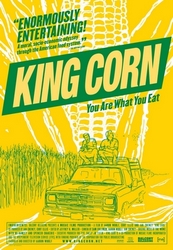 On the 38th anniversary of Earth Day, an entire generation of Americans born after the introduction of this much-mocked and undervalued holiday/celebration/day of pondering can now be affectionately referred to as the “Children of the Corn.†On the 38th anniversary of Earth Day, an entire generation of Americans born after the introduction of this much-mocked and undervalued holiday/celebration/day of pondering can now be affectionately referred to as the “Children of the Corn.â€
Anyone who pays the slightest attention to the ingredient lists of most of the food items sold at the conventional grocery stores across this country would know this, except the American consumer seems to do very little research while buying things that go directly into her body. This is why we need more investigative reporting and more documentary films on the subject of food. This is why King Corn, directed by Aaron Woolf, Ian Cheney and Curt Ellis, is important viewing for the average American consumer.
In King Corn, Woolf, Cheney (we hope of no relation the Cheneys of Wyoming) and Ellis spell out in very basic terms, what has gone so wrong with American agriculture and its direct product, American food. They present their hardest evidence first: Ellis and Cheney have their strands of hair analyzed at the University of Virginia. The result: the carbon in their bodies originated from corn. The two Ivy League grads seem shocked and appalled. They run to the grocery store and start reading labels of their favorite food products such as Twinkies and apple juice. They find out the obvious — most packaged foods in America contain some derivative of corn, whether it comes in the form of corn oil, the infamous and ubiquitous high fructose corn syrup or the mysterious xanthan gum.Â
Instead of doing the East Coast elitist exposé composed of interviews with nutritional and agricultural talking heads (which does happen in small bits in the latter half of the 90 minutes), the directors take a softer, more personal approach to the controversial subject.
Ellis and Cheney, best friends from Yale, decide to move to Iowa for a year and grow corn to find out what happens with it. It’s not quite as extreme as the personal sacrifice of Morgan Spurlock with Supersize Me! or as abrasive (yet entertaining) as Michael Moore with his ambush interviews, but it’s an effort at least appreciated by the rural farm folk of Iowa (at first.) Read the rest of this entry »
|
|
|
|
| |
|
|
|
|
|
|
|
By Umut Newbury
December 18, 2007
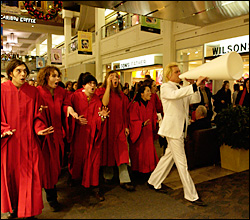 It is seven days from Christmas 2007 and that puts us one step closer to Shopocalypse according to Rev. Billy of the Church of Stop Shopping. It is seven days from Christmas 2007 and that puts us one step closer to Shopocalypse according to Rev. Billy of the Church of Stop Shopping.
No American shopper would want to be bothered by the true impact of her consuming behavior at this time of the year. Christmas is so instilled in our social existence in North America that even the most conscientious, eco-friendly and sustainable-living oriented folks out there want to make exemptions to please loved ones. No one wants to be the Grinch. Director Rob VanAlkemade’s documentary What Would Jesus Buy? is a sobering film about the lengths we all go to avoid being the Grinch and how we are hurling ourselves toward Shopocalypse because of our consumerism and over-consumption. Read the rest of this entry »
|
|
|
|
| |
|
|
|
|
|
|
|
By Umut Newbury
October 10, 2007

Tom Jackson’s Out of Balance: ExxonMobil’s Impact on Climate Change, which premiered on satellite television channel World Link this week, exposes not only exactly what this big oil company has done to spin the debate on global warming but also tells us specifically why we should not buy into its propaganda.
In Out of Balance, Jackson arms himself with a number of climate change experts such as Michael Oppenheimer and Bill McKibben. These experts take us step by step through the facts surrounding global warming. For example, it is a known fact that there is a link between carbon dioxide and temperature. Scientists have collected data from ice cores that can tell us how atmosphere and temperature changed over the last 400,000 years. What they found is that the warming of the last few decades is inconsistent with the natural warming patterns of our planet.
The United Nations General Assembly called for an assessment of climate change almost 20 years ago – in 1988. The best climate scientists of the world wrote a report, which was reviewed by hundreds of other scientists. By 1995, the world scientists were in a consensus: This is going to be a serious problem.Â
Many people have argued since Hurricane Katrina that obviously climate change is not so bad or it doesn’t exist, because we have not had another Katrina. The scientists Jackson interviews clarify this fallacy once and for all. Global warming does not mean that there will be an increase in the number of storms per se, but the tropical storms that do form will become stronger because of the warming oceans.
Bill McKibben points out that though we are all responsible for the unusual warming of our planet, every problem has a face and the image of global warming includes ExxonMobil and its former CEO Lee Raymond.Â
While considered a hall of famer in the area of CEOs who maximize shareholder profitability, Raymond also is known for managing to delay action on climate change for over a decade. Jackson points out that while many large energy corporations such as BP are trying to green their image with slogans like “Beyond Petroleum,†ExxonMobil is proud to be just an oil company. Read the rest of this entry »
|
|
|
|
| |
|
|
|
|
|
|
|
By Umut Newbury
August 24, 2007
 Film is still one of the best mediums out there for grassroots action. Film is still one of the best mediums out there for grassroots action.Â
What else could have the power to bring together nonprofit groups from New York, community activists from the Midwest, and students, academics, farmers and foodies to a sleepy little college town in Kansas?Â
Before the screening of the “Go Organic!†short film series in Lawrence, Kan., on Aug. 23, one could sign up to rally against the exploitation of farm workers by Burger King; speak out against genetically engineered rice farming experiment in Junction City, Kan.; or learn about a biodiesel bus trip across America.
The Lawrence-based nonprofit Films for Action, Local Burger restaurant and the New York-based nonprofit Sustainable Table were the presenting partners of the screening. Rural Route Films, a New York nonprofit which highlights films that deal with rural places and people, originally put the series together and offered it up for screenings nationwide. (Check the group’s myspace page for upcoming screenings: www.myspace.com/ruralroutefilmfestival)
Sustainable Table was in town as a part of their “Eat Well Guided Tour of America,†a bus tour which started in California earlier this month and is headed to New York for this year’s Farm Aid concert on Sept. 9.Â
The featured speaker of the evening was the new local celebrity Simran Sethi, host/writer of the Sundance Channel’s new program, “The Green,†and a lecturer at the University of Kansas School of Journalism. She quickly set the tone for the evening: “We are what we eat and where we eat. The choices we make for food not only affect our health, but our community and economy.â€
Hilary Brown, owner of the Local Burger restaurant in Lawrence, Kan., provided the free organic fare for the audience before the screening and offered one solid advice: “Educate yourself about genetically engineered food.â€
Tim Hjersted of Films for Action explained the beginnings of his nonprofit group in 2006. “We realized that the way the overcome many of the problems we’re facing today is to overcome the media itself.â€Â The Films for Action group has been showing documentaries locally for a $2 admission and is also planning on a free lending library of all the DVDs in its collection.
The evening started with by now the very-Internet-famous, The Meatrix. The brainchild of the Sustainable Table group, The Meatrix, is not a documentary short, but rather an anime information film about factory farming. It has enjoyed wide popularity for its witty and cute spinoff on the blockbuster movie, The Matrix. In this short, instead of Keanu Reeves, we get Leo the pig who takes the red pill from Moopheus and sees the truth about factory farming. The Meatrix, as Moopheus puts it, is “the lie we tell ourselves about where our food comes from.â€
First on the “Go Organic!†series was Frankensteer from Alberta, Canada. Frankensteer examines how the modern agriculture industry took the cow and experimented with it to turn it into the perfect food machine. The film features stunning footage of Alberta’s “Feedlot Alley,†where one million cows are housed and slaughtered each year. From the bird’s eye view shots, all we see are muddy, dirty open-air pens where hundreds of thousands of cows are squeezed in together. Directors Ted Remerowski and Marrin Canell then take us to Bob Kerr’s free-range cattle farm, where cows graze happily on green pasture. Kerr calls it “Heifer Heaven.†The film shows how the life of the cow started to change in the 1960s, when industrial farmers figured out how to fatten it cheap and fast by what they call “grain finishing.†Rick Paskal, a feedlot operator in Alberta, says, “Grain-finished beef produces the marbled meat which the consumer demands.†But farming expert Tim McAllister explains how cows would have never evolved to eating grain naturally because it makes them sick to their stomachs. In 2005, hundreds of cows died in Alberta’s “Feedlot Alley†after eating too much grain, which made them drink too much water and freeze to death. Read the rest of this entry »
|
|
|
|
| |
|
|
|
|
|
|
|
By Umut Newbury
June 8, 2007
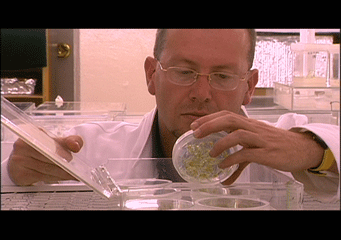 The mega-corporation, Monsanto, probably does not ring a bell in the minds of most American consumers. But it happens to be one of the main producers of the Vietnam Era’s infamous Agent Orange; the creator of farm and lawn pesticide Roundup; maker of cow growth hormone rBGH; and now the owner of more than 90 percent of all genetically engineered seed in the U.S. as well as some 11,000-plus genetically engineered seed patents across the globe. The mega-corporation, Monsanto, probably does not ring a bell in the minds of most American consumers. But it happens to be one of the main producers of the Vietnam Era’s infamous Agent Orange; the creator of farm and lawn pesticide Roundup; maker of cow growth hormone rBGH; and now the owner of more than 90 percent of all genetically engineered seed in the U.S. as well as some 11,000-plus genetically engineered seed patents across the globe.
The controversy over genetically engineered seeds and subsequently food, has been going on for quite some time and gets very little coverage in the mainstream media. So, what is an informed, concerned citizen to do to alert her fellow eaters? Deborah Koons Garcia, writer and director (also the wife of the late Jerry Garcia) decided to explore the whole issue in an 88-minute documentary titled, The Future of Food. Read the rest of this entry »
|
|
|
|
| |
|
|
|
|
|
|
|
 By Umut Newbury By Umut Newbury
March 5, 2007
What do Frank Sinatra, Gene Kelly, Katharine Hepburn, Humphrey Bogart, Danny Kaye and John Huston have in common?
They are legendary Hollywood stars beloved to this day by average Americans. No one would dare call them unpatriotic today. In September of 1947, they had the courage to form a group called the Committee for the First Amendment to stand up and protest the infamous McCarthy witch hunt of House Committee on Un-American Activities.
In the following 60 years, Americans seem to have forgotten that sometimes, it takes high profile celebrities to capture the spotlight and speak up against government activities that regular folks question. Somehow, in the post 9/11 world, we are OK with gawking at photos of Tom Cruise’s baby, Britney Spears’ head shaving adventures and the televised custody proceedings for Anne Nicole Smith’s orphaned infant. But we’ve made sport of making fun of the likes of Tim Robbins, Susan Sarandon, Sean Penn and Kanye West. We want to know every little dirty secret of our celebrities, except for what they have to say about what’s going on in the world.
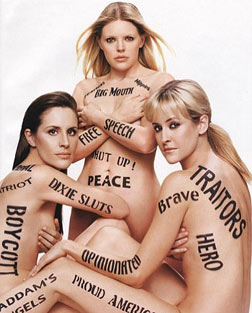
Enter into this twisted worldview some unlikely characters and you’ve got a very fascinating documentary about the Orwellian madness in which we live. Shut Up & Sing chronicles the First Amendment battle of the Dixie Chicks – three Texan country stars who previously brought the American public such culturally illuminating songs as “Goodbye Earl.â€
In 2003, Natalie Maines, Emily Robison and Martie Maguire sang the national anthem at the Super Bowl. They were the best selling female group of all time and Lipton tea was the official sponsor of their “Top of the World†tour. It just so happened that at the same time, the United States was preparing to go to war in Iraq. When the Dixie Chicks showed up in London on March 10, there were thousands of people in the streets rallying against the war. With that backdrop to their concert, Natalie Maines did what a lot of entertainers would have done, which is to make sure that the frustration people feel about some people from Texas does not spread to others like herself and her bandmates. So, she said a few words: “We’re with you on this one. We don’t want this war. We’re ashamed that the president of the United States is from Texas.†And the crowd cheered loudly. The band had a great performance, their manager Simon Renshaw told them they rocked the house and they moved on to their next stop. In the meanwhile, The Guardian proceeded to quote Maines and the U.S. media soon followed. Within days, the reputation as well as the lives of three good ole girls from the Lone Star state would change forever. Read the rest of this entry »
|
|
|
|
| |
|
|
|
|
|
|
|
By Umut Newbury
December 13, 2006
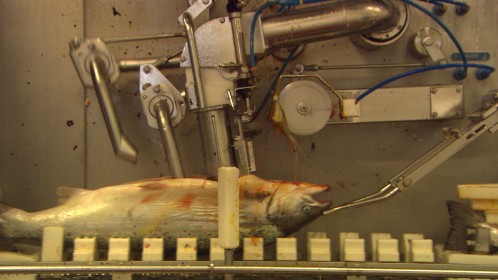
For several years now, the Organic Consumers Association in the United States has been referring to genetically engineered foods with the affectionate phrase: “Frankenfoods.â€
Austrian filmmaker Nikolaus Geyrhalter’s latest documentary, Our Daily Bread, illustrates grimly in about an hour and a half how all food, crops and animals, raised in the industrial agricultural system qualify as Frankenfoods.
Our Daily Bread shows us the nightmare that is producing food for 6 billion of us on this planet in the 21st century. We all partake in it everyday of our lives, yet so few of us really think of where our food comes from. Geyrhalter has tracked down for us exactly where filet mignon and eggs and bacon, even tomatoes, peppers and apples come from, and it is not pretty. The 21st century human being is so cut off from the reality of foodstuffs that it seems the more we don’t look, the worse it gets.
Geyrhalter spent two years across Europe on factory farms, shooting images of pigs, cows and chickens being slaughtered by the thousands. Think of the scene in Baraka where the accidentally hatched baby chicks were being gassed in an egg factory, then multiply it by as dozen or so times. Unlike Baraka, there is not a score substituting for narrative in Our Daily Bread. Geyrhalter’s piece is virtually quiet, except for the sound of machines, muffled human voices and lots and lots of water hoses. There are so many shots of cleaning and watering in the film, it is difficult not to remember Lady Macbeth. Human beings industrialized food production and brought it indoors to confined crowded environments and the result is lots of blood and chemicals that need to be washed from the bunny suits of workers, the floors and the equipment again and again. But water will not wash our sins away and the workers in Geyrhalter’s film seem to be aware of this. The only thing more disturbing in the film than the cruel and unusual treatment and killing of the animals is the situation of the people who work at these factories. Though we have managed to invent lots of machines to help with the dirty work, it seems the most gruesome duties are still reserved for the human workers. There has to be a person to give a cow a C-section, a person euthanize pigs and a person to cut off the heads of chickens. None of the factory farm workers in Our Daily Bread look happy or pleased with their jobs.
 The situation in the fields does not look any brighter. In one scene, a field of beautiful flowers is suddenly overshadowed by a crop duster spraying pesticides; in many others Geyrhalter shows us acres and acres of land devoted to the cultivation of one single plant. Workers in these fields and greenhouses seem like robots picking produce, watering or applying a concoction of chemicals. We even get a glimpse of a field supervisor with his binoculars watching the workers on the field, reminding us of the ironic similarity to days of plantations and slavery. Even salt miners look dehumanized as they travel hundreds of feet below the European continent and find themselves in a massive maze of gigantic tunnels for the simplest of dinner table items. The situation in the fields does not look any brighter. In one scene, a field of beautiful flowers is suddenly overshadowed by a crop duster spraying pesticides; in many others Geyrhalter shows us acres and acres of land devoted to the cultivation of one single plant. Workers in these fields and greenhouses seem like robots picking produce, watering or applying a concoction of chemicals. We even get a glimpse of a field supervisor with his binoculars watching the workers on the field, reminding us of the ironic similarity to days of plantations and slavery. Even salt miners look dehumanized as they travel hundreds of feet below the European continent and find themselves in a massive maze of gigantic tunnels for the simplest of dinner table items.
We have put an end to the reign of the family farm, the natural biodiversity and ecological balance. We have consolidated food production, putting it under roofs that house hundreds of thousands of chickens and pigs, we have invented machines and conveyor belts to make the production faster, and the people who now work for feeding the world look like zombies. All this, for what? Cheap food and lots of it, for sure. There are so many mouths to be fed in this world that naturally food production needed to increase and live up to the demand. But a first year economics student could easily tell that this has to do not just with supply meeting demand but with profit-making as well. There is nothing inherently wrong with desiring a profitable industry and feeding the world at the same time, but the those of us who consume the products of this morally disturbing system meal after meal must start asking the question, “At what cost?â€
Geyrhalter said this in a recent interview:
“… it becomes the scandal of how we live, because this economic, “soulless†efficiency is a reciprocal relationship with our society’s lifestyle. There is nothing wrong with saying, “Buy organic products! Eat less meat!†But at the same time it’s kind of excuse, because we all enjoy the fruits of automation and industrialization and globalization every day, which affect much more than just food.â€
It’s true and Geyrhalter’s chosen technique in Our Daily Bread, sans narration or score, helps the viewer contemplate upon this.
This film should be required viewing for anyone who eats. These images should be replaying in every consumer’s head while buying groceries or ordering lunch at a restaurant. It is time we stop corn-syrup coating the hellish nightmare we call food in the 21st century.
—–
Directed by Nikolaus Geyrhalter
92 minutes/ Color
2005
Purchase at First Run/Icarus Films
|
|
|
|
| |
|
|
|
|
|
|
|
By Umut Newbury
November 26, 2006
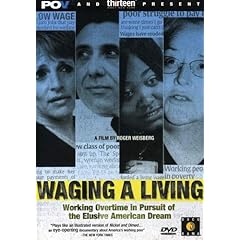 Since their victory on Nov. 7, the Democratic leaders have pledged to make raising the minimum wage among their top priorities. If they want to accomplish that goal they should make sure to have all of their Republican colleagues view Roger Weisberg’s Waging a Living before the debates begin. Since their victory on Nov. 7, the Democratic leaders have pledged to make raising the minimum wage among their top priorities. If they want to accomplish that goal they should make sure to have all of their Republican colleagues view Roger Weisberg’s Waging a Living before the debates begin.
The federal minimum wage has remained at $5.15 per hour since 1997. According to The New York Times, when adjusted for inflation, the buying power of the wage has dropped to its lowest level since 1955. By December, The Times reported recently, the minimum wage will have remained unchanged for the longest period since it was established in 1938.
Weisberg follows four Americans over a period of three years in Waging a Living, three women and one man. Jean Reynolds, a rest home nurse in New Jersey, is recently divorced and is taking care of her children, one of whom is a 29-year-old cancer patient, and her children as well. Jerry Langoria, a security guard in San Francisco earns $12 per hour, but can only afford a small room in a hotel for $530 per month.
Weisberg points out several facts throughout the documentary such as, after 10 years, of those who start in poverty 50 percent stay there. After a divorce, in the year following a man’s standard of living increases by 10 percent while a woman’s decreases by 27 percent. An estimated 18,000 Americans die every year for lack of health insurance. Read the rest of this entry »
|
|
|
|
| |
|
|
|
|
|
|
|
 Who would frame somebody with a Gardenburger? Who would frame somebody with a Gardenburger?
In the real world, probably, no one. At the Renfrew Center in Florida, where the documentary THIN takes place, one anorexic named Shelly believes the staff of the rehabilitation center does.
Lauren Greenfield’s debut as a documentary filmmaker is not for the faint of heart. In the United States, we have come to believe that the food we are eating is making us fat, which it is. The majority of American adults are clinically overweight or obese (more than 63 percent according to 2005 studies). However, there are also five million people who suffer from eating disorders that keep them too thin. Greenfield opens the film with a little known and shocking truth: one in seven anorexic women will die from complications caused by their disease.
She takes us on a dark journey inside the Renfrew Center, one of a handful of treatment centers in the nation for women who suffer from anorexia or bulimia, most often both. We first meet Shelly, a psychiatric nurse who enters the clinic at a whopping 84.3 pounds. Polly comes to the center after attempting suicide over two “pieces†of pizza. She does admit on camera that the cheesy-doughy goodness wasn’t the only thing that led her to slice her wrists, but she adds, “that was the straw that broke the camel’s back.†Brittany is 15 and she’s had eating disorders since she was eight. She went from 185 pounds to 95 in one year and it becomes clear to the viewer that perhaps she didn’t have the best role model around her when she starts talking about the “chew and spit†candy parties that her mother initiated. When her mother comes to visit Brittany at the center, she picks through her plate right in front of her child. Another woman, Alisa, says she developed her eating disorder after hearing the pediatrician deem her fat when she was 7 years old. She recounts graphically a typical day in her life: She would drive to Dunkin’ Donuts and buy a dozen doughnuts then to Burger King and McDonald’s to buy large orders of breakfast items, all to bring them home, eat them in their entirety and vomit profusely afterwards. Read the rest of this entry »
|
|
|
|
|
|