| |
|
|
|
|
|
|
|
By Bryan Newbury
Twitter:Â @asiplease
 As a reviewer, I am usually loath to do what I just did. Namely, first-person reviews or reactions. I always cringe seeing that “I†on a page, whether it is here or in the New York Times. Certain subjects demand stripping any pretense of objectivity, though, and American: The Bill Hicks Story is definitely one of them. This is because Bill Hicks is my comedian. I caught his One Night Stand in Chicago on the cusp of my formative years and it changed me as a person. I made sure to tape it on second airing and proceeded to memorize every bit in it… despite the fact that, unlike Mr. Hicks, I did not consider comedy a viable career option. That thirty minutes was up there with anything Pryor had ever done. It was all mine. As a reviewer, I am usually loath to do what I just did. Namely, first-person reviews or reactions. I always cringe seeing that “I†on a page, whether it is here or in the New York Times. Certain subjects demand stripping any pretense of objectivity, though, and American: The Bill Hicks Story is definitely one of them. This is because Bill Hicks is my comedian. I caught his One Night Stand in Chicago on the cusp of my formative years and it changed me as a person. I made sure to tape it on second airing and proceeded to memorize every bit in it… despite the fact that, unlike Mr. Hicks, I did not consider comedy a viable career option. That thirty minutes was up there with anything Pryor had ever done. It was all mine.
Until five years later, when Bill Hicks started popping up in all sorts of places. The most memorable encounter I had with Hicksmobilia was at the apartment of a person I didn’t know from Adam. He lived upstairs from a friend of mine and had the beer or taco sauce or whatever we were lacking at that particular moment. In the corner of his living room was a framed portrait of Bill Hicks. It took three glances to confirm, but there it was. Memories are tricky things, and they often graft embellishments into the psyche, but I swear it was an oil painting. Now, that is commitment to a comedian.
A few of these experiences were enough to find out that Bill Hicks had a following. In his case, the word ‘following’ is more what we’d ascribe to the Dalai Lama or Rabindranath Tagore than, say, Bob Saget. As the years go by, that following gets larger and more fervent, revelatory and more high profile. (I am thinking here of Keith Olbermann’s ‘Bill Hicks is still ahead of his time’ segment.) As is the pattern with genius, this all comes well after Hicks ‘left in love, in laughter, and in truth,’ largely because his message and material become more incredibly incisive with every passing war, crisis or bastardization of the aesthetic landscape.
 If Hicks is your comedian, you’ve no doubt seen every bit of video available, listened to each album – listened to it backwards as well – know every bit by heart from Randy Pan the Goat Boy to We Live In A World to Ding Dong (the last one is incredibly timely) and have by this time discovered that there were layers of meaning and bits of cosmic truth that become more evident in 2011 than in 1999. You don’t need my recommendation to see American. Tough shit. You’re getting it. If Hicks is your comedian, you’ve no doubt seen every bit of video available, listened to each album – listened to it backwards as well – know every bit by heart from Randy Pan the Goat Boy to We Live In A World to Ding Dong (the last one is incredibly timely) and have by this time discovered that there were layers of meaning and bits of cosmic truth that become more evident in 2011 than in 1999. You don’t need my recommendation to see American. Tough shit. You’re getting it.
–Read the rest of this entry »
|
|
|
|
| |
|
|
|
|
|
|
|
A reaction by Bryan Newbury
Twitter: @asiplease
A little more than half way through The Most Dangerous Man in America, there is a revelation worthy of its own feature length film: What if a person sacrificed his occupation, family and freedom to get the truth to the American public and nobody seemed to care? This takes up only a few minutes of screen time, but, from where the viewer sits, seeing 162 Tomahawk missiles fall on Libya while two seemingly endless wars go on in Iraq & Afghanistan and Julian Assange rotates headquarters from a charming country home in England to a courtroom in Stockholm to – why the hell not? – a subterranean compound beneath the Denver airport, it is the point most deserving of rumination.
There can be no doubt that much of the acclaim The Most Dangerous Man in America has received since its opening stems from the inescapable parallels of Vietnam and whichever current war you choose. This documentary would have been valuable in 1997, to be sure, but there is no denying the importance of its message at this moment.
While the reviewer is proposing new features stemming from this film, allow him to go one further, if indeed it hasn’t been done. Why not give us two additional hours on the lies behind every war? Better still, how about a film that spends all its time asking just how a nation can turn around in the span of one generation and lose the lessons which so many of us always suspect, but in the case of Daniel Ellsberg’s release of The Pentagon Papers was proven in black and white?
To hear the Nixon tapes, to be reminded of the fact that the Vietnam War was being planned by Eisenhower and Kennedy, if through proxies or by our own military, up until the Gulf of Tonkin “attack†which served as the cover story catalyst for an 11-year disaster that resulted in the loss of over two million lives, untold treasure and a considerable blow to our international reputation, to see the footage from Washington to Saigon, is to beg another question; namely, what in the hell is wrong with us?
After all, the lies leading up to the Iraq War were fairly transparent and in plain view to anyone who cared to look. We needed no Ellsberg… we had UN reports. The rationalizations were the same, though, and they shall surely remain so until the public calls its leaders out on the ruse.
If we are to stretch out ever so slightly to divine that symbolic, poetic meaning of The Most Dangerous Man in America, it is the disheartening cliché that the more things change, the more they stay the same. It is telling that Ellsberg found a strange resistance among anti-war legislators when he attempted to circulate his secret history of the Vietnam War through them. We see Howard Zinn explain this, commenting on the culture of deference and capitulation within the legislative branch. It is difficult to escape the feeling that it goes beyond deference. Is it possible that public debate is simply an act of theater, with the real decisions being made in corridors of power that aren’t available on CSPAN? The more one looks into it, the less outlandish this contention appears.
Things stay the same in the public mind, which never ceases to find a way to ignore revelations like The Pentagon Papers, Wikileaks, the recent piece in Der Spiegel and countless others. Many go beyond the bounds of a normal life in their condemnation of diversions and frivolity. It is hard to imagine how one can stay sane without basketball games, a bit of comedy, etc. Still, disconcerting is too small a word when considering the American public’s ability to answer crimes and horrors with a shrug.
As with all poetic, symbolic imagery, the aforementioned isn’t quite precise. As we learn, 1970’s America isn’t exactly analogous to the America of the 2000’s. For starters, the Horatio to Ellsberg’s Hamlet turns out to be a brave and vibrant press. While we have our share of online resources that go beyond what organizations like The New York Times, The Washington Post, The Chicago Sun Times, et al. were capable of then or are now, they do little to mitigate the maddening compliance our major media has displayed for the last 30 years. Publication of the Wikileaks cables notwithstanding, it is hard to imagine today’s Times and Post coordinating so effectively under a threat as real as the Nixon Administration offered. Second, we see press freedom held up in a 6-3 Supreme Court vote. If you think that the current Judiciary, which we learn is basically the only coequal branch of government to our Executive, would walk out on that limb against the interests of our politicians and profiteers, it is probably best that you return to diversions and frivolity.
The courage and consequence of Daniel Ellsberg’s actions cannot be questioned. The Most Dangerous Man in America is a tremendous appraisal of the man, his path, his life. As the film posits, it is quite clear that The Pentagon Papers were integral in the downfall of a presidency if not the immediate conclusion of a war. What is unnerving about these findings is that, while presidents come and go, wars seem to live out their own biographies. Whether it is Vietnam from Eisenhower to Nixon – and let us not forget the two gentlemen in-between – or Iraq from Bush to Obama and, lamentably, beyond, the continuity of agenda is equal parts perplexing and maddening. One cannot help but think that altering this reality doesn’t require heroic acts by the Daniel Ellsbergs of the world. It only requires that we listen to them.
—-
The Most Dangerous Man in America: Daniel Ellsberg and the Pentagon Papers
Directed by Judith Ehrlich & Rick Goldsmith
Color and Black & White, 92 minutes, 2009
|
|
|
|
| |
|
|
|
|
|
|
|
SXSW is starting this weekend, and documentary news will quickly be dominated by the now established film part of this festival. Here are a few resources to find out what is going on and what films will likely get a lot of coverage.
Go right to the source for speeches and film screenings information at the SXSW Film page.
Documentaries about entertainment personalities will certainly dominate much of the film news coming out of Austin.  A Willie Nelson documentary directed by Billy Bob Thornton will be shown, and Conan O’Brien’s tour documentary will premiere. But don’t forget about some of the smaller films.
A good spotlight on some of the Documentary Shorts that will be shown at SXSW.  Many films are mention but the highlights include: Frank Fairfield, My Big Red Purse and Library of Dust.
If you are looking for just films in general,  check out this list of possible hits.
If you are fortunate enough to be going to SXSW, have a great time. Â The rest of us will be watching from afar; awaiting the day when these documentaries are distributed to a wider audience.
|
|
|
|
| |
|
|
|
|
|
|
|
One of our writers are has been working on an informative social media blog, that we wanted to point you to if you have an interesting in social media.  The site is LLSocial.com and it also features a social media podcast that offers news and interviews.
As a note to our long time fans of the Documentary Films. Net site.  We are working to get more reviews and information on the site.  If you have ideas for content or format changes, let us know.  We want to provide relevant information, but outside time constraints on our writers and editors has had much of the content come to a stop, and we apologize for that.
|
|
|
|
| |
|
|
|
|
|
|
|
By Bryan Newbury
August 3, 2010
Being a product review, as the film review by Michael Sragow precludes any further efforts at reviewing the film, which shall be discussed presently…
 Aficionados of old time music, to understate matters a bit, tend to be completists. They may specialize in one genre or even one artist. Some, given the right conditions and resources, fill rooms with 78’s and hard drives full of obscure material. Others are named Joe Bussard. Regardless of what category an OTM obsessive falls under, there is little doubt that he will be purchasing a copy of Terry Zwigoff’s unsurpassable Louie Bluie, the DVD Edition of which is soon to be available from The Criterion Collection. Aficionados of old time music, to understate matters a bit, tend to be completists. They may specialize in one genre or even one artist. Some, given the right conditions and resources, fill rooms with 78’s and hard drives full of obscure material. Others are named Joe Bussard. Regardless of what category an OTM obsessive falls under, there is little doubt that he will be purchasing a copy of Terry Zwigoff’s unsurpassable Louie Bluie, the DVD Edition of which is soon to be available from The Criterion Collection.
If for nothing else, the film is worth owning based on footage alone. Yank Rachell trading quips with Howard “Louie Bluie†Armstrong… Armstrong giving longtime partner Ted Bogan endless grief while haggling him out of a pair of Technicolor trousers… Armstrong reminiscing with an old acquaintance in La Follette, Tennessee… Armstrong back in Chicago, sharing his indescribable work, ABC’s of Pornography… and then, there’s the music.
These would certainly be enough to merit repeated viewings. That Zwigoff crafted the film with an uncanny dexterity is simply a bonus.
Louie Bluie does what all good documentaries on the subject should do, provided the film has the advantage of firsthand footage of the performers: it gives the viewer the impression of being a visitor, taking in the scenes as they happen. Zwigoff eclipses such outstanding filmmakers as Les Blank in his deft touch, convincing the viewer that he is such a visitor, while interspersing the straight interview material in such a way that he feels that the archival footage comes from a story and the pictures of earlier days were sat on your lap in the form of a large album, the kind with defective adhesive and stubborn vellum paper. It could be argued that a character as immense as Armstrong might have deserved more lionizing treatment, (this is a man who, despite the storybook childhood we all expect – that of poverty, fish fries, barn dances, a preaching father, etc. – managed to speak enough Italian to get by in Chicago’s immigrant quarters, boasts a calligraphy that is immaculate, and parallels artists as imminent as Louis Paul Boon in his literary pornography), and no doubt a study of Armstrong the autodidact would be a very worthy undertaking, but that is another project altogether, and one Zwigoff hadn’t the resources to accomplish. Besides, that would be a profound turnoff to the OTM enthusiast, this film’s primary audience.
–Read the rest of this entry »
|
|
|
|
| |
|
|
|
|
|
|
|
 The red and white logo of Coca-Cola is one of a few international brands recognized so instantly and globally. If there is life outside of Earth, Coca-Cola would be one of the brands that would be recognized universally, too, because even Martians would have seen the Coke Santa, which debuted in The Saturday Evening Post before World War II. It’s a ubiquitous product that has made itself a lifestyle choice of billions of people. The red and white logo of Coca-Cola is one of a few international brands recognized so instantly and globally. If there is life outside of Earth, Coca-Cola would be one of the brands that would be recognized universally, too, because even Martians would have seen the Coke Santa, which debuted in The Saturday Evening Post before World War II. It’s a ubiquitous product that has made itself a lifestyle choice of billions of people.
The Coca-Cola Company didn’t achieve this by creating a product so essential to human life; instead it managed to win people’s hearts and minds by having an extremely positive and successful marketing campaign. People all over the world associate Coke products with the pursuit of happiness and an improved quality of life. From its 1963 slogan, “Things Go Better with Coke,†to the 1979 “Have a Coke and a Smile,†to the 2001 “Life Tastes Good;†its jovial Santas making an appearance each year and even the World Cup mascot every four years on the collectible cans, Coca-Cola has worked hard to make us happy while quenching our thirst with the magically fizzy combination of water and sugar (or high fructose corn) syrup. (Full disclosure: This reviewer began drinking Coca-Cola at the age of 4 and for the next quarter century or so was one such content customer, turning to Coke products for refreshment and pleasure with a daily consumption of multiple glass bottles at first, then cans and then the 20-ounce plastic bottles before finally kicking the habit in 2004.)
For those current happy-go-lucky Coca-Cola fans out there, directors German Gutierrez and Carmen Garcia have some grim news to deliver in their new documentary, The Coca-Cola Case. Their film takes that pleasant image of Santa Claus decked out in red and white and replaces it with the blood of international bottling plant workers and the pale white faces of corpses.
–Read the rest of this entry »
|
|
|
|
| |
|
|
|
|
|
|
|
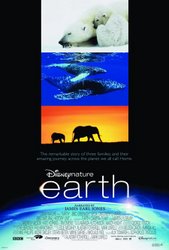 In the 1940s, The Walt Disney Company began to make full-length documentaries featuring nature as its subject. These films were billed under the title of Disney True-Life Adventures, and they won several Academy Awards for the studio. In the 1940s, The Walt Disney Company began to make full-length documentaries featuring nature as its subject. These films were billed under the title of Disney True-Life Adventures, and they won several Academy Awards for the studio.
Now, 60 years later, Disney is heading back to nature for a new series of films called DisneyNature films. Last year, the first of these films was released on Earth Day 2009, and that movie was Earth. Though the movie has been out on DVD for a while, I decided to finally sit down and watch it.
Earth opens with a stunning view of our planet from outer space. This first shot sets the scene for the rest of the movie, which is truly huge in scope. The movie chronicles everything from the thrilling chase of a caribou by a wolf, crane migration in the Himalayas and a slow-motion great white shark attack.
But the three main creatures the filmmakers follow in Earth are a family of humpback whales, a polar bear father on the quest for food and a herd of elephants making a long migration. Each story is told with surprising care and accompanied with stunning footage.
The man leading us on our journey is none other than the voice of Mufassa himself, James Earl Jones. Scenes of the African landscape are particularly moving when accompanied by Jones’ voice, but maybe that’s just the nostalgia of my Lion King days.
Some scenes in Earth might look familiar to viewers. The same filmmaking team behind the BBC/Discovery Channel series Planet Earth created the movie, so naturally some of the footage is similar. Regardless, the stories and scenes displayed in Earth are amazing.
One of the true highlights of the movie is the musical score from George Fenton, who also crafted the music for the Planet Earth series. His music is epic, and it definitely brought out the music geek in me. The soundtrack was an instant addition to my Wish List on iTunes.
Though the film is captivating, it does have its flaws. It seems that Disney was so intent on keeping this movie squeaky-clean and family friendly that it shows almost none of the harsh realities of the animal kingdom. Each time an animal gets ready to pounce on its prey, the camera conveniently cuts away. More graphic images have probably been seen in an issue of National Geographic Kids. This movie is about as G-rated as you can get.
Minor flaws aside, Earth is a great movie for anyone looking for an informative documentary, or even just a flat-out entertaining adventure. I wanted even more after it ended.
DisneyNature is giving its audiences just that with one new documentary film each year. Oceans was released last month on Earth Day and the film African Cats will hit theaters Earth Day 2011. Other future movies include The Crimson Wing: Mystery of the Flamingos, Hidden Beauty: A Love Story that Feeds the Earth and Chimpanzee.
|
|
|
|
| |
|
|
|
|
|
|
|
By Bryan Newbury
March 9, 2010
 Many say that America is a Christian nation. Among those claimants, there is a burgeoning ideology, which seeks to reclaim the historical record – the same crew have been marginally successful with this approach towards pure science, so there is little reason to doubt that history would be any less malleable – and put an image of snake handling evangelicals in the place of pragmatic deists. Dubious as their claims are, the Christian nationalists, for want of a better moniker, do have one bit of fact on their side: nominally, at least, the majority of Americans do identify as Christians. In Capitalism: A Love Story, Michael Moore poses the question, “So, are we?†Many say that America is a Christian nation. Among those claimants, there is a burgeoning ideology, which seeks to reclaim the historical record – the same crew have been marginally successful with this approach towards pure science, so there is little reason to doubt that history would be any less malleable – and put an image of snake handling evangelicals in the place of pragmatic deists. Dubious as their claims are, the Christian nationalists, for want of a better moniker, do have one bit of fact on their side: nominally, at least, the majority of Americans do identify as Christians. In Capitalism: A Love Story, Michael Moore poses the question, “So, are we?â€
Not being a scholar in divinity or a professed member of any religious group, it isn’t for this reviewer to sit in judgment. Having a cursory knowledge of the Gospels as they are laid out in the King James Bible, it is tempting to come down with a thunderous No. The reader likely will refuse to take this verdict, or, for that matter, Mr. Moore’s. Luckily, Moore provides credentialed men of the cloth to posit that if we are a Christian nation, we are nonetheless governed by a profoundly unchristian economic system. (Should there be confusion as to whether we are governed by an economic system rather than a political one, there is an instructive dialogue with an editor at The Wall Street Journal to allay that head scratcher.)
As usual, Moore builds his case on whimsical educational films from more innocent times, cataloguing the avaricious transgressions of the ruling class and juxtaposing those iniquities with the inevitable inequities and how they play out in those locales that the populations of Washington and Wall Street couldn’t give a good goddam about. It is a bit of a departure, however, to see the Flint of twenty years ago becoming the template for contemporary Miami. Moore has documented the progression, and we should be thankful for it. At this point, we all know what we know to expect, but where does Capitalism fit in the Moore œuvre?
Peculiarly, though expectedly, as a sort of prequel.
 While the chronology and scenery suggest the conclusion to a larger body of work archiving the devolution of our republic from free state to fiefdom, there is reason to consider viewing Capitalism as Part I. were one to introduce Michael Moore to an alien observer. (Begging pardon if the observation has been made here before on the last of Moore’s “last†films, but this installment supplants the whole order of things where a marathon Michael Moore viewing is concerned.) After all, the narrative arc from Roger & Me to Sicko, including as it does our propensity for gun violence and general distaste for actual democracy, to say nothing of our “medieval health care nonsystem,†in the words of Rachel Maddow, is informed by a devaluation of human life and functional liberty. What is the true exception in American exceptionalism? An ideology of individualism as manifested by callousness towards our fellow man seems to be at the root of it. How can we stand alone among industrialized countries in both violent crime and lack of health care access? Look no further than the fundamentally unchristian nature of our republic’s economic system. While the chronology and scenery suggest the conclusion to a larger body of work archiving the devolution of our republic from free state to fiefdom, there is reason to consider viewing Capitalism as Part I. were one to introduce Michael Moore to an alien observer. (Begging pardon if the observation has been made here before on the last of Moore’s “last†films, but this installment supplants the whole order of things where a marathon Michael Moore viewing is concerned.) After all, the narrative arc from Roger & Me to Sicko, including as it does our propensity for gun violence and general distaste for actual democracy, to say nothing of our “medieval health care nonsystem,†in the words of Rachel Maddow, is informed by a devaluation of human life and functional liberty. What is the true exception in American exceptionalism? An ideology of individualism as manifested by callousness towards our fellow man seems to be at the root of it. How can we stand alone among industrialized countries in both violent crime and lack of health care access? Look no further than the fundamentally unchristian nature of our republic’s economic system.
–Read the rest of this entry »
|
|
|
|
| |
|
|
|
|
|
|
|
Despite producer controvery and strong competition from Food, Inc, Â The Cove won the Oscar for best documentary.
Reaction to the win:
“The Cove” is the unsurprising winner for best documentary, beating out the other socially conscious picture “Food, Inc.” More controversial: One of the winners holds up a save-the-dolphins text-message number onstage, which seems like a pretty clear infraction of the academy’s no-promotion rules for the podium, even if it is a promotion for a good cause. @LA Times
An Oscar win by “The Cove,” a documentary chronicling bloody dolphin hunting in a Japanese fishing town, could give the film the critical audience its makers wanted to reach: ordinary moviegoers in Japan.
News that the movie won the Academy Award for best feature documentary was greeted with surprise in Japan because many Japanese hadn’t heard of it. The U.S. film, directed by former National Geographic photographer Louie Psihoyos, hasn’t been shown in commercial theaters in Japan except for a single viewing during the Tokyo International Film Festival in October.
Japanese theaters have stayed away from it because of protests from the town of Taiji, a fishing town of 3,800 people in Western Japan that bills itself as the “birthplace of Japan’s commercial whaling.” The town’s officials requested the film’s Japanese distributor drop it, saying it was shot without permission of its people and constituted libel. @Wall Street Journal
“The Cove” edges out “Food, Inc.” Both films will be useful to aliens in explaining why our species deserved to go extinct. @tildology
|
|
|
|
| |
|
|
|
|
|
|
|
Beverly Hills, CA — Nominee credits for Best Documentary Feature nominee “The Cove” have been determined by the Academy of Motion Picture Arts and Sciences’ Documentary Branch Executive Committee. Credits are as follows:
“The Cove” – Louie Psihoyos and Fisher Stevens
Academy rules for the documentary feature category state that a maximum of two persons may be designated as nominees, one of whom must be the credited director, and the other of whom must have a producer or director credit. Psihoyos is the film’s director, Stevens has a producer credit.
|
|
|
|
| |
|
|
|
|
|
|
|
Best documentary feature
“Burma VJâ€
A Magic Hour Films Production
Anders Østergaard and Lise Lense-Møller
“The Coveâ€
An Oceanic Preservation Society Production
Nominees to be determined
“Food, Inc.â€
A Robert Kenner Films Production
Robert Kenner and Elise Pearlstein
“The Most Dangerous Man in America: Daniel Ellsberg and the Pentagon Papersâ€
A Kovno Communications Production
Judith Ehrlich and Rick Goldsmith
“Which Way Homeâ€
A Mr. Mudd Production
Rebecca Cammisa
|
|
|
|
| |
|
|
|
|
|
|
|
It is fitting that the film begins with Larry Craig, who, by the way, is totally not gay. He wasn’t gay in the gay scene in Washington during the early eighties, he wasn’t gay when hooking up with other men a decade later, and he certainly wasn’t gay when rubbing feet in the stall of a Minneapolis airport W.C. If you need proof, his wife, and her three children from a previous marriage, will say so. Were it not for this incident, a project like Outrage might never see the light of day. Salacious as the trysts of David Dreier, Jim Kolbe and James McGreevey may be, they’d likely be swept under the rug save for Craig’s inspired moment in Prince’s hometown.
Using the Craig incident as a springboard, Dick launches into the seedy underbelly of D.C. nightlife. It should be said that the only way in which we can call it seedy with any modicum of intellectual honesty is in its covert nature. That people are hooking up in this den of iniquity isn’t altogether shocking… actually, the hole-and-corner nature of these lavender couplings is equally discernible… what stands out is the lengths to which our media goes to in an effort to maintain secrecy. The money moment in Outrage is a scene with Bill Maher on The Larry King Show that split-screens Maher’s actual comments on Ken Mehlman with the redacted broadcast. (Sadly, no Jeff Gannon references follow.)
It is telling that our media elite run interference on the story. If anyone is revealed as a villain in Outrage, it is them. Upon looking at the story, any sentient being can determine that the problem isn’t with evangelicals or their ilk exclusively; rather, it is with our society as a whole. Excepting our obtuse concept of sexuality, the road of hypocrisy and idiocy couldn’t be such an effortless excursion. The collective failure to come to terms with the vagaries of human sexuality reinforces those lies we insist on being told.
That reticence results in a general distaste for the concept of outing. The debate has raged for generations, pitting the sacrosanct dispensation for privacy against the interest of the body politic. It would be easy to err on the side of privacy were it not for the craven scapegoating of people based upon their genital preferences. An instructive scene in the film comes from criticizing Mary Cheney. To the majority, her failure to use public prominence in correcting our outlook appears prudent. When seen through the lens of a distressed minority, it is manifest as nothing short of cowardice, or worse, cynical posturing. In a society that accepts biological deviations from the norm, outing would be unnecessary. In one where Matthew Shepard dangles from a fencepost, it becomes mandatory.
Outrage won’t tell you anything you don’t already know if you’ve been paying
By Bryan Newbury
January 27, 2010
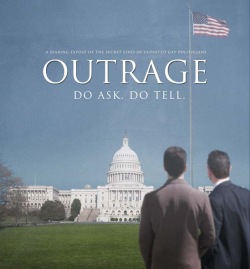 Aside from a pun, there isn’t a conceptual device more deservedly pilloried than a truism. If there is a hobgoblin of discourse, this is indubitably the worthiest candidate. To say they are rhetorically ubiquitous is to fall into their clutches. It is with knowing rancor that this reviewer participates in this lowest form of colloquy, yet it needs to be said: if a person in public life becomes exorcised about an issue regarding genitalia, one can be certain that the behavior he or she (mostly he) rails about is one in which that person engages overtly, maliciously and often flamboyantly. Aside from a pun, there isn’t a conceptual device more deservedly pilloried than a truism. If there is a hobgoblin of discourse, this is indubitably the worthiest candidate. To say they are rhetorically ubiquitous is to fall into their clutches. It is with knowing rancor that this reviewer participates in this lowest form of colloquy, yet it needs to be said: if a person in public life becomes exorcised about an issue regarding genitalia, one can be certain that the behavior he or she (mostly he) rails about is one in which that person engages overtly, maliciously and often flamboyantly.
This is the general point behind Kirby Dick’s Outrage. The film’s concept is simple enough; namely, the people behind the most baleful and far-flung acts of legislative bigotry are the very same that participate in the actions legislated against.
It is fitting that the film begins with Larry Craig, who, by the way, is totally not gay. He wasn’t gay in the gay scene in Washington during the early eighties, he wasn’t gay when hooking up with other men a decade later, and he certainly wasn’t gay when rubbing feet in the stall of a Minneapolis airport W.C. If you need proof, his wife, and her three children from a previous marriage, will say so. Were it not for this incident, a project like Outrage might never see the light of day. Salacious as the trysts of David Dreier, Jim Kolbe and James McGreevey may be, they’d likely be swept under the rug save for Craig’s inspired moment in Prince’s hometown.
Using the Craig incident as a springboard, Dick launches into the seedy underbelly of D.C. nightlife. It should be said that the only way in which we can call it seedy with any modicum of intellectual honesty is in its covert nature. That people are hooking up in this den of iniquity isn’t altogether shocking… actually, the hole-and-corner nature of these lavender couplings is equally discernible… what stands out is the lengths to which our media goes to in an effort to maintain secrecy. The money moment in Outrage is a scene with Bill Maher on The Larry King Show that split-screens Maher’s actual comments on Ken Mehlman with the redacted broadcast. (Sadly, no Jeff Gannon references follow.)
It is telling that our media elite run interference on the story. If anyone is revealed as a villain in Outrage, it is them. Upon looking at the story, any sentient being can determine that the problem isn’t with evangelicals or their ilk exclusively; rather, it is with our society as a whole. Excepting our obtuse concept of sexuality, the road of hypocrisy and idiocy couldn’t be such an effortless excursion. The collective failure to come to terms with the vagaries of human sexuality reinforces those lies we insist on being told.
That reticence results in a general distaste for the concept of outing. The debate has raged for generations, pitting the sacrosanct dispensation for privacy against the interest of the body politic. It would be easy to err on the side of privacy were it not for the craven scapegoating of people based upon their genital preferences. An instructive scene in the film comes from criticizing Mary Cheney. To the majority, her failure to use public prominence in correcting our outlook appears prudent. When seen through the lens of a distressed minority, it is manifest as nothing short of cowardice, or worse, cynical posturing. In a society that accepts biological deviations from the norm, outing would be unnecessary. In one where Matthew Shepard dangles from a fencepost, it becomes mandatory.
Outrage won’t tell you anything you don’t already know if you’ve been paying attention. Those that run on family values are often the furthest from their objectives. The biggest enemy of human rights is the self-loathing striver. Barney Frank is a national treasure for his devotion to honesty. Shepard Smith was a twisted sexbot long before Roxxxy. It might shine a light on these unfortunate truths for those still laboring under the misapprehension that family values is anything but a marketing scheme. If one eye is opened, it is well worth the venture.
—–
Outrage
Written & Directed by Kirby Dick
Color, 90 minutes, 2009
|
|
|
|
| |
|
|
|
|
|
|
|
U.S. DOCUMENTARY COMPETITION
This year’s 16 films were selected from 862 submissions. Each film is a world premiere.
Bhutto (Directors: Jessica Hernandez and Johnny O’Hara; Screenwriter: Johnny O’Hara)—A riveting journey through the life and work of recently assassinated Benazir Bhutto, former Pakistani prime minister and a polarizing figure in the Muslim world. World Premiere
CASINO JACK & The United States of Money (Director: Alex Gibney)—A probing investigation into the lies, greed and corruption surrounding D.C. super-lobbyist Jack Abramoff and his cronies. World Premiere
Family Affair (Director: Chico Colvard)—An uncompromising documentary that examines resilience, survival and the capacity to accommodate a parent’s past crimes in order to satisfy the longing for family. World Premiere
Freedom Riders (Director: Stanley Nelson)—The story behind a courageous band of civil rights activists called the Freedom Riders who in 1961 creatively challenged segregation in the American South. World Premiere
Gas Land (Director: Josh Fox)—A cross-country odyssey uncovers toxic streams, dying livestock, flammable sinks and weakening health among rural citizens on the front lines of the natural gas drilling craze. World Premiere
I’m Pat _______ Tillman (Director: Amir Bar-Lev)—The story of professional football star and decorated U.S. soldier Pat Tillman, whose family takes on the U.S. government when their beloved son dies in a “friendly fire” incident in Afghanistan in 2004. World Premiere
Jean-Michel Basquiat: The Radiant Child (Director: Tamra Davis)—The story of artist Jean-Michel Basquiat, whose work defined, electrified and challenged an era, and whose untimely death at age 27 has made him a cultural icon. World Premiere
Joan Rivers: A Piece of Work (Directors: Ricki Stern and Annie Sundberg)—A rare, brutally honest glimpse into the comedic process and private dramas of legendary comedian and pop icon Joan Rivers as she fights tooth and nail to keep her American dream alive. World Premiere
Lucky (Director: Jeffrey Blitz)—The story of what happens when ordinary people hit the lottery jackpot.
World Premiere
My Perestroika (Director: Robin Hessman)—Intimately tracking the lives of five Muscovites who came of age just as the USSR collapsed and are adjusting to their post-Soviet reality, My Perestroika maps the contours of a nation in profound transition. World Premiere
The Oath (Director: Laura Poitras)— Filmed in Yemen, The Oath tells the story of two men whose fateful encounter in 1996 set them on a course of events that led them to Afghanistan, Osama bin Laden, 9/11, Guantanamo, and the U.S. Supreme Court. World Premiere
Restrepo (Directors: Sebastian Junger and Tim Hetherington)—Sebastian Junger and Tim Hetherington’s year dug in with the Second Platoon in one of Afghanistan’s most strategically crucial valleys reveals extraordinary insight into the surreal combination of back breaking labor, deadly firefights, and camaraderie as the soldiers painfully push back the Taliban. World Premiere
A Small Act (Director: Jennifer Arnold)—A young Kenyan’s life changes dramatically when his education is sponsored by a Swedish stranger. Years later, he founds his own scholarship program to replicate the kindness he once received. World Premiere
Smash His Camera (Director: Leon Gast)—Jacqueline Kennedy Onassis sued him, and Marlon Brando broke his jaw. The story of notorious, reviled paparazzo Ron Galella opens a Pandora’s Box of issues from right to privacy, freedom of the press and the ever-growing vortex of celebrity worship. World Premiere
12th & Delaware (Directors: Rachel Grady and Heidi Ewing)—The abortion battle continues to rage in unexpected ways on an unassuming corner in America. World Premiere
Waiting for Superman (Director: Davis Guggenheim)—Waiting for Superman examines the crisis of public education in the United States through multiple interlocking stories—from a handful of students and their families whose futures hang in the balance, to the educators and reformers trying to find real and lasting solutions within a dysfunctional system. World Premiere
|
|
|
|
| |
|
|
|
|
|
|
|
By Bryan Newbury
November 18, 2009
 Recently, The New York Times ran a piece speculating upon what our thankfully nearly late decade should be dubbed. Among other ghastly appellations were The Era of Misplaced Anxiety and The Decade of Overshoot, to say nothing of the North going South and The Decade of Disruptions. Watching The Garden while looking back at the aughts, one is tempted to leap to hyperboles of wickedness so pernicious that he might be accused of striking at least a passing resemblance to the Yahwist. Recently, The New York Times ran a piece speculating upon what our thankfully nearly late decade should be dubbed. Among other ghastly appellations were The Era of Misplaced Anxiety and The Decade of Overshoot, to say nothing of the North going South and The Decade of Disruptions. Watching The Garden while looking back at the aughts, one is tempted to leap to hyperboles of wickedness so pernicious that he might be accused of striking at least a passing resemblance to the Yahwist.
The past decade has been nothing if not a paean to fiendishness. Attempts to define it and label it fall short not for lack of nuance; rather, these years burden the sensibilities with iniquities every bit as vile as they are complete that they bewilder the observer beyond reason. If one is inclined to bemoan the violations of American empire against its subjects and enemies, he is bound to recognize the equally dreadful thoughts and actions of the victims. As Wall Street speculated away the wealth of many nations, it did so with the consent of its victims, who were hoping for a share in the Sachs spoils. This decade has been an age without victims… all have come well short of the glory, or so says the reporting.
The Garden goes further than any documentary of the decade in defining an age where everything good has suffered from the rot of unthinking avarice. The story is simple enough and much to familiar in narrative arc. To be as succinct as possible, there once was a community garden in South Central Los Angeles tended by its (largely Latino) residents with nearly transcendental results. The plot was purchased by the city from a developer, whose irredeemably black soul shall be dealt with presently, following the riots of 1992. As time went on, the land was observed to have a great value in graft by an unscrupulous city councilwoman and erstwhile community activist. The land was sold back to the contemptible fellow in an extralegal process with the help of the corrupt councilwoman and the clout of the nefarious activist in order to line their pockets.
It would be a pedestrian tale were it not for the fact that the South Central Farmers had done something that is all too rare in our age: they made something beautiful and good.
To recount the abhorrent acts of venality and violence that occur would do a disservice to a film that should be seen by all. It is difficult to watch at times and equally difficult to describe without resorting to sloganeering reminiscent of the Paris commune. What transpires is a depiction of solid, honest people – even when they are at their worst, even as they battle amongst themselves – being thrown to the rapacious hydra that has become fully evolved in our America: the three devouring heads of corporatism, cronyism and complacency.
The corporatism is easy enough to understand. Ralph Horowitz is a grasping bastard bereft of a soul that sells high and buys low (truth be told, sells same buys same, but with the passing of time the depiction fits, as does the rhyme) and eventually refuses to sell higher still because of his contempt for humanity. In short, a businessman.
Juanita Tate and Jan Perry were likely human at one time. Perry became involved in institutional politics, which inevitably corrupts. If there is doubt on that, research what your Congresspeople have received in contributions from insurance and pharmaceutical lobbyists within the last few years. Tate saw her golden ticket and punched it after years of activism. The examples of Tate and Perry set against that of Horowitz clearly illustrate a growing cognitive dissonance in popular thought. Business is irreparably amoral and government is irrevocably unethical. Meanwhile, business and government present themselves as adversaries. Business creates wealth which government taxes and government manages to regulate while business prevaricates. This becomes pure theatre when both aspire to similar aims. So, is it complacency when the victims of business protest the government charged with protecting them and their counterparts wail about those same agents advancing their cause?
In many ways, yes. Even as we inveigh against self-important celebrities sticking their noses in issues of public policy, we ignore every plight that doesn’t draw a camera. (The Garden is replete with celebrity appearances, from Danny Glover and Darryl Hannah to Joan Baez and Willie Nelson.) It is only natural to be consumed with outrage as the film draws to a close, but how often are we speechless witnesses to crimes such as these? What use is any of it if, to borrow from Phil Ochs, it wouldn’t interest anybody outside of a small circle of friends?
It is nearly impossible to encapsulate the topics orbiting around the basic story told by The Garden. To give an honest and in depth accounting of the racial issues would require more space than is available here. When the spectre of antisemitsm is raised in regard to Mr. Horowitz to a bemused group of Mexican Americans who are in jeopardy of losing something great they’ve created, when we see African Americans on both sides of the fight, when we see those African Americans endeavoring to steer the issue into a brown on black battle (one area among many that Dan Stormer distinguishes himself as both ethical and intelligent) and when we see the LAPD exercise their trademark brutality on the South Central Farmers it defies definition. It seems to simply be, which might be the ultimate indictment on us, our decade, our species.
The Garden is a morality tale equally simple and multi-faceted where evil prevails. It reminds this reviewer of a Woody Guthrie statement that new and better curse words are required to describe certain people. It is a ballad depicting the conflict between verdancy and decency with the bankrupt ideology of mammon, the clash of humanity and saurian predation. Hopefully, it is the coda to a decade marred with needless acquisitiveness and an instructive document informing us of how we’ve gone wrong. In any event, it is as useful an interpretation of where we are and how we got there as the medium is likely to give us.
—–
The Garden
Written & Directed by Scott Hamilton Kennedy
2008, Color, 80 minutes
|
|
|
|
| |
|
|
|
|
|
|
|
By Bryan Newbury
October 5th, 2009
 Thank a merciful Christ I live in Lawrence. Thank a merciful Christ I live in Lawrence.
This affirmation begins the day for many residents of Lawrence, Kan., which, as the bumper stickers say, represents 27 miles of reality surrounded by Kansas. Not that Lawrencians head en masse to their numerous coffee shops reciting the phrase with their various other Bikram-related mantras; however, they will often be heard to say something like this after watching the state news or a film such as Laura Cohen & Joe Winston’s What’s the Matter with Kansas? Judging from What’s the Matter, Kansas can be a pretty scary place. A scary place with a long and obscured history festooned with the better angels of progressivism, but a scary place nonetheless.
The film takes its lead from Thomas Frank’s book of the same title, and can be forgiven for lacking the depth of the written word. Unfortunately, the portrayal the viewer is provided can tend toward myopia to the point of farce. Where Frank provides a thoughtful analysis of what could be called the Kansas Problem… namely, the issue of white working class voters casting ballots against their own economic interests… Cohen and Winston appear content to show us a vision of an evangelical backwater obsessed with the holy fetus.
Frank isn’t blameless as a writer, and it is important to stress that the Chicagoans who made What’s the Matter take a considerable lead from the Prairie Village, Kan. product. (For the benefit of readers who aren’t from Kansas, Prairie Village is to the state of Kansas as Plano is to Houston’s Fifth Ward circa 1983.) Being an actual Kansan – that is, a product of a depressed rural area who went to school in a depressed urban area – it is the reviewer’s duty to suggest that both Frank and the filmmakers could’ve spent a little more time with people like M.T. Ligget.
 Ligget, from Mullinville, provides a picture of the kind of Kansan most of us grew up with and around. The cantankerous septuagenarian delivers the most enjoyable lines in the film (“Gay marriage… who gives a shit?â€) as well as a more accurate depiction of the attitudes of rural Kansans. If someone were inclined to plumb the depths of the flyover psyche, people like Ligget are the place to start, not the Barden family. The Bardens are the caricature that seems to comfort urban sophisticates the nation over. In one scene, we see the mother, called “mommy†even by her adolescent children, driving her brood to the bleeding Creation Museum in Kentucky. Brittany, the eldest daughter, eventually attends Patrick Henry College in Virginia, America’s leading educational outlet for folks uncomfortable with the whole “established science†thing. Throughout What’s the Matter, we’re inundated with people likely to TiVo The Colbert Report without thinking for a second that the program is satire, to say nothing of the terrorist splinter groups in and around Operation Rescue. One can just imagine Angelinos and Chicagoans moaning “Is this what is going on in Red America?†Well, is it? Ligget, from Mullinville, provides a picture of the kind of Kansan most of us grew up with and around. The cantankerous septuagenarian delivers the most enjoyable lines in the film (“Gay marriage… who gives a shit?â€) as well as a more accurate depiction of the attitudes of rural Kansans. If someone were inclined to plumb the depths of the flyover psyche, people like Ligget are the place to start, not the Barden family. The Bardens are the caricature that seems to comfort urban sophisticates the nation over. In one scene, we see the mother, called “mommy†even by her adolescent children, driving her brood to the bleeding Creation Museum in Kentucky. Brittany, the eldest daughter, eventually attends Patrick Henry College in Virginia, America’s leading educational outlet for folks uncomfortable with the whole “established science†thing. Throughout What’s the Matter, we’re inundated with people likely to TiVo The Colbert Report without thinking for a second that the program is satire, to say nothing of the terrorist splinter groups in and around Operation Rescue. One can just imagine Angelinos and Chicagoans moaning “Is this what is going on in Red America?†Well, is it?
The short answer, to borrow from Sarah Palin, is kinda’. It can’t be argued that these people aren’t out there in considerable number. They are. They’re in Wichita, Cleveland, Dallas, New York, even San Francisco. Do they represent a larger segment of Kansas’ population than that of Oregon or Massachusetts? Of course. To say that the megachurch-attending rube tips the electoral scales of our sylvan landscapes, however, does a disservice both to rural Americans and to our understanding of how our political realities are forged. After all, the year in which What’s The Matter was filmed saw the trouncing of the ultra-right’s favored candidates at the polls even in Kansas. Much is made of the candidacy of Phill Kline, still his loss in the AG’s race seems an inconvenient footnote, along with that of Jim Ryun and Kris Kobach.
Getting back to Ligget. The Frank formula, at the risk of oversimplification, is “God, guns and gays,†which is to say that social issues dominate the electoral map. Let it be submitted that one can safely omit God and gays from this calculation. One wonders what the producers made of Ligget’s take on Iraqi insurgents. The fellow, straight out of central casting, clad in overalls and baseball cap – the unofficial uniform of the rural Kansan – suggests that we reverse the rolls and imagine another country invading our own and dictating to us what our political system and cultural mores are to be. If you take up arms against that invading force, would you be an “insurgent� “I know I would,†the man says without hesitation. Kansans, like most other small staters, are fiercely independent and mistrustful of anything resembling authoritarian or even official. Understanding this is paramount to getting past the bewilderment caused by analyzing the perceived cognitive dissonance of the rural voter. Credit where it’s due, the segments with Donn Teske go a long way in this direction. To an inattentive viewer, Teske’s stances seem like welcome bulwarks against a  Christofascist uprising, when indeed he is representative of exactly the mindset that makes Kansas fundamentally conservative. He is a populist, true, but he introduces himself as a “populist without a party.†What does that mean? Could it be that the Kansan outlook recognizes that neither party represents the interests of the lower classes? In one instructive scene, Teske tours The Garden of Eden, Samuel Perry Dinsmoor’s eccentric artistic and philosophical statement in stone. The mass sculpture, located in Lucas, has a centerpiece depicting the worker on a cross, being crucified, or bled, by lawyer, doctor, preacher and banker. Teske opines that there’s a lot of truth to it. This doesn’t mean that he is running to the local Democratic Party call center. Quite the contrary. Teske’d likely see it how many Kansans do: if the banker and preacher represent a Republican point of view, what do we say of the lawyer and doctor? There’s the rub. Like Teske, Ligget proclaims a great hatred for George W. Bush. This doesn’t necessarily serve as an endorsement for Bush’s official opposition. It only conveys a cynicism that we can find one half hour before Stephen Colbert’s speaking satiric truth to crazy.
In the end, Kansas isn’t the creationist lunatic asylum the film might suggest any more than the radical utopian outpost of Frank’s history books and graveyards. It is much more akin to the film’s Garden City scenes: awash in the Christian ethos that brought us both free clinics and clinic bombings, beleaguered by economic inequality, profoundly untrusting of bureaucracy yet collectively susceptible to simple solutions to complex problems, the latter being possible largely because no major political entity represents (or is allowed to represent) reasonable solutions to the problems life in the American outback is rife with. Could it be that we’ve spent a few too many years wondering what’s the matter with Kansas? Imagine Ralph Nader getting his five per cent or Ross Perot expanding his Reform Party beyond a genital measuring contest with his fellow Texans. Possibly Ronn Teske would be a populist with a party then. It leads one to wonder what the matter might be with California, New York, or any of the 2000 election’s other “safe†states.
—–
What’s the Matter with Kansas?
Produced by Laura Cohen and Joe Winston
Color, 90 Minutes, 2009
|
|
|
|
| |
|
|
|
|
|
|
|
By Bryan Newbury
August 7, 2009
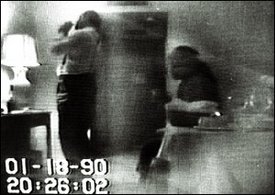 Bitch set me up. Bitch set me up.
Chances are, when someone outside of Washington, D.C. mentions the name Marion Barry, those four words will enter into the conversation. Like all things dealing with race in the United States, the jovial treads a very thin line before falling off of the precipice into the hateful. In the Middle West, we have a longstanding tradition of jovial skewing towards hateful. Hopefully, these little jabs come off for entertainment over beers. To claim that there is never a bit of racially charged humor in those bull sessions would be duplicitous. At the risk of breaking a little news, these conversations still happen in our new postracial America.
The unwelcome news in postracial Obaman America, of course, is that the jovial is rapidly ceding territory to the hateful. For some reason, farmer-tanned minions throughout our land seem unwilling to share in the collective joy we right-thinking individuals relish in regarding our first African-American president, our first Latina Supreme Court justice and a new release by Eminem. “White America,†whatever that might mean, is astonishingly adept at adopting a mentality of victimhood, and it appears that the lightly satiric Midwestern quips are increasingly becoming drowned out by verbiage more reminiscent of the Old South. Midwesterners tell funny stories, they say. Southerners tell stories funny. There is a world of difference.
When one throws something like The Nine Lives of Marion Barry into this confusing milieu, the results will be decidedly mixed.
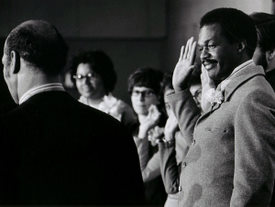 Outside of the District, and especially outside of the black community, the consensus is that Mr. Barry is a base pipe toking womanizer who has outlived his public usefulness. Inside of the District and its black community, the former is a forty-sixty proposition. The sixty readily identify with Mr. Barry’s trials and tribulations, having experienced the siege of narcotics and violence in their community, having lived through broken homes bought about in many respects by the willful efforts of the Anglo power structure to break those homes and communities. As the film points out early on, the District operated as an odd plantation protectorate well into the 1970’s, being administered by gents like John McMillan of South Carolina . Barry was indispensable in the fight to “Free D.C.†and make it possible for citizens of the overwhelmingly black city to enjoy basic rights other Americans take for granted, such as electing a city council and mayor.* Outside of the District, and especially outside of the black community, the consensus is that Mr. Barry is a base pipe toking womanizer who has outlived his public usefulness. Inside of the District and its black community, the former is a forty-sixty proposition. The sixty readily identify with Mr. Barry’s trials and tribulations, having experienced the siege of narcotics and violence in their community, having lived through broken homes bought about in many respects by the willful efforts of the Anglo power structure to break those homes and communities. As the film points out early on, the District operated as an odd plantation protectorate well into the 1970’s, being administered by gents like John McMillan of South Carolina . Barry was indispensable in the fight to “Free D.C.†and make it possible for citizens of the overwhelmingly black city to enjoy basic rights other Americans take for granted, such as electing a city council and mayor.*
The Nine Lives of Marion Barry follows the rise and fall and resurrection and fall and rise and stumbling and rising again of Barry alongside that of his city, weaving in and out from historical context to his 2004 run for city council from Ward Eight, a notoriously hard-hit area of our nation’s capital. There is little hint of hagiography here. Effi Slaughter, Barry’s ex-wife, gets the lion’s share of interview time. It is easy to relate to her. Probably as easy as District residents find it to relate to their former mayor. She gives a cogent reckoning of her relationship with Mr. Barry, from his charismatic rise in D.C. activism and politics to his 1990 arrest and beyond.
–Read the rest of this entry »
|
|
|
|
| |
|
|
|
|
|
|
|
By Bryan Newbury
July 12, 2009
 Is it possible for a Kennedy to be overlooked and underappreciated? If you’re inclined to agree with or admire Senator Edward M. Kennedy, a viewing of HBO’s Teddy will certainly lead you to an affirmative answer. Is it possible for a Kennedy to be overlooked and underappreciated? If you’re inclined to agree with or admire Senator Edward M. Kennedy, a viewing of HBO’s Teddy will certainly lead you to an affirmative answer.
Teddy begins in Denver, at the 2008 Democratic Convention. In terms of sheer artistry, vigor and conviction, his 1980 speech had this one beat. In filling out the Odyssean narrative that has been Teddy’s life, it couldn’t be more fitting. The speech, relatively soon after Kennedy’s being diagnosed with a large brain tumor, serves to sum up the man rather than the youngest brother. While it is true that simply being a Kennedy must define a person in many ways, Teddy is larger than that. A little thing like a brain tumor isn’t going to silence, stop, or even slow this fighter down.
That irrepressibility is the oil that lubricates the endearment of his fans and the ire of his detractors. Teddy Kennedy has a long list of formidable foes, from Nixon to the generation of conservatives after him to many in his own party to the vagaries of fate itself. No one would sooner assent to his life of privilege than the man himself, but even the fiercest of composers of enemies lists would grant that the senator from Massachusetts isn’t going to shy away from a fight.
To those detractors, there isn’t much in Teddy to like. The film, narrated by Kennedy, sticks its toe right to the hagiography line. Like everything else regarding Kennedy or politics in general, whether that line is crossed depends entirely on one’s persuasion. Chris Matthews will likely give this work an enthusiastic five-star endorsement. Rush Limbaugh’s review is surely to be more reserved. Though it goes far to illustrate the courage, convictions and strength of character Kennedy prides himself on, Teddy doesn’t avoid things that aren’t exactly comfortable subjects. Naturally, there are the untimely deaths of his siblings – Kunhardt and Nevins deserve much respect for treating the shootings of Jack and Bobby with the propriety so many have chosen to discard – his son’s bout with bone cancer, a plane crash, the wreckage of which would lead one to surmise that the passengers hadn’t a chance of surviving, let alone walking again, a few tips of the bottle, a failed campaign for the Democratic nomination and…
–Read the rest of this entry »
|
|
|
|
| |
|
|
|
|
|
|
|
By David Loftus
June 24th, 2009
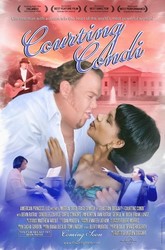 By now, many of us have grown accustomed to films that make us uncomfortable. By now, many of us have grown accustomed to films that make us uncomfortable.
There have been documentaries that showed us unpleasant truths, whether old (“The Fog of Warâ€) or new (“An Inconvenient Truthâ€), and plenty of pop films which thrived on humiliating their heroes (from “There’s Something About Mary†to “Flirting With Disasterâ€) while we laughed and, to a degree perhaps, empathized.
Just when you thought nothing new could be done outside of CGI animation, particularly in the documentary format, here comes “Courting Condi,†dubbed a “musical docu-tragi-comedy†by its makers. Part road picture, part buddy movie, part musical, and yes, part straight documentary at the same time as it’s almost a parody of documentaries, “Courting Condi†is often funny, sometimes downright silly, and occasionally startling as a whack upside the head.
One might also drag out that aging, much-abused term “post-modern†here. But I wouldn’t want you to think there’s anything stuffy or academic about “Courting Condi.†Simply, it’s the “story†of a chubby loser of a young musician who conceives a great love for George Bush’s Secretary of State, and – under the illusion they could somehow meet, date, and end up as soulmates – tracks her life and career from Birmingham, Alabama to Washington D.C. by way of Denver and Palo Alto (Stanford University).
 Slowly but surely, it also morphs from a ridiculous shaggy-love tale (our Romeo makes several MTV-style music videos he calls “love disks†and is shown mailing them to his beloved) to the real-life depiction of a good Christian girl (a playmate of one of the four girls killed in the 1963 bombing of the Sixteenth Street Baptist Church in Birmingham) and African-American scholar … who underwent a transformation into a corporate board fixture after whom an oil tanker was named, who enjoyed the assistance of affirmative action but punished and ignored others who did the same, who overlooked civil slaughter in Nigeria and lied about Iraq, and who okayed the torture of Muslim prisoners. Slowly but surely, it also morphs from a ridiculous shaggy-love tale (our Romeo makes several MTV-style music videos he calls “love disks†and is shown mailing them to his beloved) to the real-life depiction of a good Christian girl (a playmate of one of the four girls killed in the 1963 bombing of the Sixteenth Street Baptist Church in Birmingham) and African-American scholar … who underwent a transformation into a corporate board fixture after whom an oil tanker was named, who enjoyed the assistance of affirmative action but punished and ignored others who did the same, who overlooked civil slaughter in Nigeria and lied about Iraq, and who okayed the torture of Muslim prisoners.
What’s especially pomo about the movie is its ploy of putting writer-director-producer Sebastian Doggart inside the story, as a documentary film director who follows the “co-star†– lovestruck Devin Ratray, acting under his own name as well – in pursuit of the title character, who of course never appears on camera by choice but only in archival footage (and as an animated cut-out, among other things).
 The character of “Doggart†in the film is clearly depicted as being much less intelligent than the real filmmaker (a King’s College, Cambridge graduate in the social and political sciences, and veteran director of stage and TV documentaries on both sides of the Atlantic), just as Ratray (whose acting resume includes Buzz in two “Home Alone†movies and several episodes of “Law and Orderâ€) can’t possibly be as credulous and foolish as he appears in this movie. The climax (or nadir, depending on how you look at it) of their buddy relationship occurs midway through the movie when “Doggart†tries to convince “Ratray†during a beach shoot that the narrative arc demands a nude scene. The character of “Doggart†in the film is clearly depicted as being much less intelligent than the real filmmaker (a King’s College, Cambridge graduate in the social and political sciences, and veteran director of stage and TV documentaries on both sides of the Atlantic), just as Ratray (whose acting resume includes Buzz in two “Home Alone†movies and several episodes of “Law and Orderâ€) can’t possibly be as credulous and foolish as he appears in this movie. The climax (or nadir, depending on how you look at it) of their buddy relationship occurs midway through the movie when “Doggart†tries to convince “Ratray†during a beach shoot that the narrative arc demands a nude scene.
Early on, many viewers are apt to feel an I-can’t-believe-they’re-doing-this discomfort about the romantic premise. We’re being made to watch this loser try to catch the eye of the nation’s first black female Secretary of State, who is nearly twice his age? In the course of interviewing Rice’s childhood neighbors and friends in Alabama, the filmmakers offer a very Michael Moore moment when Ratray attempts to speak to Rice’s mother as she’s trying to get from her car in the driveway to her house and pretty much brushes them off (understandably so).
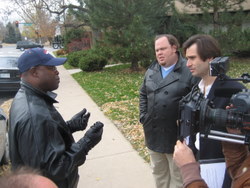 Things start to turn a little weirder – because less obviously farcical and futile – as Ratray and Doggart get Rice’s one and only ex-fiancé, former Denver Broncos receiver Rick Upchurch, to show his engagement ring and reminisce about their dates; then receive romantic advice and potential love songs from Grammy-winning composer and one-time Elvis girlfriend Carol Connors; and then put Devin through the image-making tutelage and focus-group grinder of Frank Luntz, campaign marketing wizard to a string of Republican politicians. Connors and Luntz strut their respective expertises, but they also play for the camera a little, and thereby induce a little extra vertigo in the viewer. Things start to turn a little weirder – because less obviously farcical and futile – as Ratray and Doggart get Rice’s one and only ex-fiancé, former Denver Broncos receiver Rick Upchurch, to show his engagement ring and reminisce about their dates; then receive romantic advice and potential love songs from Grammy-winning composer and one-time Elvis girlfriend Carol Connors; and then put Devin through the image-making tutelage and focus-group grinder of Frank Luntz, campaign marketing wizard to a string of Republican politicians. Connors and Luntz strut their respective expertises, but they also play for the camera a little, and thereby induce a little extra vertigo in the viewer.
–Read the rest of this entry »
|
|
|
|
| |
|
|
|
|
|
|
|
By Umut Newbury
June 15, 2009
 Last week, we saw an image of an American president that has been foreign to us for a little while. In Cairo, tens of thousands of Muslims cheered for President Barack Obama, as he spoke of a different world with a different United States leading it. He quoted from the three major Western religious texts and brought Egyptians to their feet with applause. As President Obama works on his second 100 days in the White House, it is a good time to take a look back and reflect on his campaign that brought him there. Last week, we saw an image of an American president that has been foreign to us for a little while. In Cairo, tens of thousands of Muslims cheered for President Barack Obama, as he spoke of a different world with a different United States leading it. He quoted from the three major Western religious texts and brought Egyptians to their feet with applause. As President Obama works on his second 100 days in the White House, it is a good time to take a look back and reflect on his campaign that brought him there.
Danny Schechter’s new documentary Barack Obama: People’s President, is a refreshing take on Obama’s campaign to the presidency. Rather than cutting and pasting coverage of talking heads telling us how Obama became the president, Schechter tries an old technique known to print journalists of yesteryear: showing it. His film opens with the famous “Yes We Can†video created by will.i.am and continues with 90 minutes of very diverse footage of the grassroots campaign that got Obama elected.
Anyone who was an official volunteer for the Obama campaign, or an unofficial volunteer (disclosure here, this reviewer was one of them) who lobbied friends, relatives, neighbors to register to vote, donate money, vote and pass on the word will enjoy seeing this big picture view of the campaign. As for those who voted and volunteered for other candidates, they would be mistaken to dismiss this film as a victory dance. People’s President lays out the steps of the Obama campaign’s success for anyone willing to learn how it was done.
The theme of Schechter’s film is the people behind the people’s candidate. Schechter’s premise is simple enough: Obama’s success lies in his campaign’s innovative use of the Internet and other new technologies, which helped lure the youth vote and reach out to many other hard-to-get constituencies. The film has footage of self-described Obama Camps across the nation, as well as an array of creativity the campaign fostered on the Internet, from will.i.am to Obama Girl and to lesser-known clips such as the “Irish Obama†and “How Obama won the KKK.†Schechter also has some experts analyzing all of this, such as NBC’s Jonathan Alter and MoveOn.org’s David Fenton. Hendrik Hertzberg of The New Yorker magazine recollects his meeting with Obama as the moment he realized that the candidate was exactly how he portrayed himself to the masses, “thoughtful, calm, disciplined, well-organized, human and strong.â€
Any campaign, Schechter argues, needs money and people. The Obama campaign got both in unforeseen amounts. Fenton says Obama won because the online tactics “broke the grip of large donors on the Democratic Party.†People like Scott Cohen describe how they felt when they heard Obama’s speech in Springfield. “I wrote the largest check of my life, for $2,300, and talked others to do so.†Cohen later had the idea to create the “An Obama Minute†video, where he asked people to give as much as they can. The first time the video aired, it raised more than $200,000.
The other strength of the Obama campaign, People’s President shows, was the superiority of its operation. The Chicago headquarters had the slogan, “No Drama with Obama.†Unlike other campaigns, there was no internal fighting, no unauthorized leaks or embarrassments. They had a tight, smooth running organization, with a simple message, “Change.†As Jonathan Alter points out, while Hillary Clinton played with different messages, the Obama campaign stuck to its original message and added a simple slogan, “Yes We Can.â€
–Read the rest of this entry »
|
|
|
|
| |
|
|
|
|
|
|
|
By Bryan Newbury
June 2, 2009Â
 “This does happen… and it can be you. Your neighbor, your son, daughter, it can happen right now, in your own home. There is no rhyme or reason why it happens. If somebody wants to do it, it can happen.† “This does happen… and it can be you. Your neighbor, your son, daughter, it can happen right now, in your own home. There is no rhyme or reason why it happens. If somebody wants to do it, it can happen.†Â
Jeff Modahl would know. One of the subjects of Witch Hunt, a film about prosecutions run mad in Kern County, California, Modahl brings fifteen years of that knowledge to this quote near the film’s conclusion. What might strike the viewer as astonishing is that it isn’t until this moment, at around eighty-two minutes in, that Witch Hunt really astonishes. Not that the story, subject matter or pacing is lacking. Not that the travails of the people profiled, all of them either wrongfully convicted of pedophilia or dealing with a life permanently altered by being party to said convictions, are in any way uncompelling. Not that Sean Penn is, as a narrator, anything short of being Sean Penn.Â
What is striking about the film is that, provided one has read about, observed or experienced the American legal system, none of the story is especially difficult to believe. Â
The early 1980’s saw Bakersfield with at least one of two problems: either there was a stunning rash of child molestation within its white working class community; or, there was an ill-trained police and social service force serving at the pleasure of a District Attorney driven to farcical lengths in zealotry and ambition. We’ll give readers five seconds to ruminate on which choice seems more likely. Â
–Read the rest of this entry »
|
|
|
|
| |
|
|
|
|
|
|
|
By Sarah Boslaugh
March 31, 2009
 Â
 You can make a movie without actors, without sound, without sets, and without a script. But you can’t make a movie without images: they’re called “moving pictures†for a reason. So it’s somewhat surprising that only two documentaries have been made about the art of cinematography: Visions of Light, directed by Arnold Glassman, Todd McCarthy and Stuart Samuels in 1992, and Cinematographer Style, directed by Jon Fauer in 2006.  You can make a movie without actors, without sound, without sets, and without a script. But you can’t make a movie without images: they’re called “moving pictures†for a reason. So it’s somewhat surprising that only two documentaries have been made about the art of cinematography: Visions of Light, directed by Arnold Glassman, Todd McCarthy and Stuart Samuels in 1992, and Cinematographer Style, directed by Jon Fauer in 2006. Â
The two films take opposite approaches.  Visions of Light included segments of many classic films along with commentary by some of the leading cinematographers of the day. Cinematographer Style includes no clips of other films. It’s composed entirely of interviews with 110 cinematographers speaking about everything from how they got into the business to the differences between working with film and video. No particular point is pursued at great length; Cinematographer Style is more of a collage of well-chosen opinions and anecdotes about the art and practice of cinematography than a tutorial or overview of the profession.Â
The 86 minutes of Cinematographer Style were edited down by Matt Blute from 33 hours of interviews (or 200 hours, according to a different source), some recorded before a black screen, some in more natural settings. That may sound like the most boring 86 minutes of your life, but it’s not: Blute arranges the interview clips thematically so the cinematographers seem to be engaged in a collective conversation about their work. Visually as well Cinematographer Style is the opposite of dull. In fact, the amazing variety of lighting and backgrounds used in what are primarily talking-head interviews itself constitutes a testimony to the cinematographer’s art. Â
Each cinematographer introduces themselves at the beginning of the film, but after that they appear without identification. Some are sufficiently famous to be recognized by their appearance alone (Allen Daviau, Gordon Willis) but many of equal accomplishment are not; it’s a largely anonymous profession and the average film-goer may not even be aware of (or interested in knowing) who was responsible for the images they see on the screen. Fauer’s choice to not identify his interview subjects furthers the impression that they are craftsmen engaged in a collective conversation about their work, without ever expecting to enjoy the kind of celebrity enjoyed by actors and directors. And to their credit, one point becomes clear immediately: for people whose work is centered on images rather than words, these cinematographers are quite articulate about what they do and why. Â
The subjects interviewed are male and female, young and old, and come from 15 different countries. Alphabetically, they range from Remi Adefarasin, BSC (a British cinematographer with extensive credits primarily in British and European television and film) to Vilmos Zsigmond, ASC (a native of Hungary who has worked in the United States since the 1960’s, and who has shot many well-known American films including Close Encounters of the Third Kind, The Deer Hunter, and The Witches of Eastwick). On average, each cinematographer has less than one minute of screen time, and it’s not surprising that some get more face time than others. First among equals (and by the way, he wants you to know that he’s a cinematographer not a director of photography) is Vittorio Storario, three-time Oscar winner for Apocalypse Now (directed by Francis Ford Coppola, 1979), Reds (directed by Warren Beatty, 1981) and The Last Emperor (directed by Bernardo Bertulucci, 1987). He also gets the primary sequence in which the art of cinematography is simultaneously demonstrated and discussed: illuminated by a single bare light bulb, Storario moves it around his face and chest to demonstrate how different he looks (and the difference in mood accomplished) simply by changing the location of the light source. Â
Cinematographer Style is of vital interest to those who shoot films and critique them. But even the more casual film fan will find a lot to appreciate in this documentary, including revelations by the cinematographers about how they chose the look of some of the most famous films of our time (everything from The Conformist to The Matrix to Gangs of New York) and how that look was achieved. Sometimes the answers are surprising: I always assumed that the color palette of The Godfather was worked out in advance, in consultations between director Francis Ford Coppola and cinematographer Gordon Willis. In fact, Willis says he decided on the film’s look about 20 minutes before shooting began, and still can’t explain why he made the choices that he did.  Â
DVD extras include extended interviews with Vittorio Storario (58 min.) and Gordon Willis (59 min.) and a biographer of director Jon Fauer. There is a scene index, but it’s not sufficiently detailed to locate particular clips, which is frustrating (but perhaps intentional, given the “collective conversation†nature of the film).
—– Â
Cinematographer Style
Docurama Films
Directed by Jon Fauer
Color, 2006, 86 Minutes
Further information, including a trailer, is available from the film’s web site, http://www.cinematographerstyle.com/, as is an accompanying book, Cinematographer Style vol. 1. The DVD of Cinematographer Style is also distributed by Docurama Films: further information is available from their web site http://www.docurama.com/ or by calling 1-800-314-8822.
|
|
|
|
| |
|
|
|
|
|
|
|
By Umut NewburyÂ
February 23, 2009
Â
 “Life isn’t some vertical or horizontal line; it isn’t neat,†declares Patti Smith early on during Dream of Life. This is true for both the subject and the style of Steven Sebring’s documentary. “Life isn’t some vertical or horizontal line; it isn’t neat,†declares Patti Smith early on during Dream of Life. This is true for both the subject and the style of Steven Sebring’s documentary.Â
Most biographical documentaries follow a linear pattern. But when a filmmaker spends 11 years (or a quarter of his life, as Sebring puts it in the booklet of the DVD), it is not possible to fit that immensity of footage into a traditional biopic format. Sebring’s Patti Smith: Dream of Life is epic, poetic and artistic, but definitely not neat.Â
The film opens like a punk rock song – in less than three minutes Smith summarizes her entire life. We learn that she was born in Chicago, got a job at a factory at age 16, moved to New York and met Robert Mapplethorpe, lived in Chelsea Hotel, married Fred Smith, had two kids. In 1989 Mapplethorpe died followed by Fred and her brother Todd’s deaths in 1994. Just exactly how a regular working-class teenager from New Jersey moves to New York and meets someone like Mapplethorpe and lives in Chelsea Hotel isn’t explained – perhaps it isn’t important, perhaps it doesn’t matter. Â
Smith’s narrative of her life during Sebring’s documentary is definitely selective. About her move to New York, all she says is that she knew there was not a chance “to be destroyed or to be created in New Jersey,†and that’s why she moved. Her descriptions of early experiences in New York are Whitmanesque. She speaks of the smells and sounds and the sky, a classic case of a young artist taking in it all in, hoping that someday, she, too, will be a part of the scenery that other young hungry minds will want to absorb.Â
Dream of Life really centers on Smith’s one quote: “Life is an adventure of our own design intersected by fate and a series of lucky and unlucky accidents.†We get a good glimpse at exactly how lucky she was. Aside from being close to Mapplethorpe, Smith also mentions nonchalantly that Sam Shepard (playwright, actor) happened to gift a 1939 Gibson to her. When she lived at the Chelsea Hotel, she would invite musicians to come see this guitar, they would play it and “that’s how I got it tuned.†The 1970s are definitely lucky years for Smith, she goes on to meet William S. Burroughs and flirt with him, even though he had to kindly remind her: “My dear, I am a homosexual.â€Â
Sebring then takes us to Smith’s childhood home and parents. Smith’s parents are the most adorable working-class parents anyone can have in New Jersey. She couldn’t have come from a more cookie-cutter home; complete with a mom obsessed with cow figurines and a softhearted dad who used to feed squirrels in his backyard. He says he stopped the feeding a while back, and adds wistfully: “They have to fend for themselves now.†One could only imagine their reaction to the likes of Mapplethorpe and Burroughs, though they seem to have accepted Patti for who she is. Smith recalls a time when she performed for the two of them before a show and says, “Only for you mom, would I do a medley.â€Â
Here is when a documentary-maker really benefits from following a subject around for more than a decade. By far, the best footage of the film is when Smith is talking about losing her brother. She explains the strange feeling one gets after losing a loved one:  “When he died, my heart became full of him. I became a better person, more optimistic.â€Â
There are many candid moments like that throughout the film, such as when Smith’s son Jackson is talking about the birthday helmet he received and just exactly what he thinks about birthdays in general. Or the part where Smith is trying to unlock the Persian urn that holds some of Mapplethorpe’s ashes. She says she got some of his ashes, so she “can travel with him.â€Â
Smith is lucky for having to meet and be close to so many special, talented people like Mapplethorpe, Burroughs, Allen Ginsberg, Gregory Corso and Michael Stipe. The unlucky part, of course, comes from seeing most of those people die. There is footage of the wake of Ginsberg and her walking around Corso’s grave. She puts that pain plainly earlier in the film when she makes the remark about “the time when all my friends were alive.â€Â
Sebring, on the whole, stays extremely loyal to Smith throughout Dream of Life. This is a biographical documentary about Smith as told by Smith. There are no interviews with friends and family when she is not present. There is no narrator but Smith. Sebring’s film is not a piece of investigative journalism; it is an essay, a poem, a painting Smith created about herself that Sebring captured. Smith doesn’t talk much about her husband Fred, or the details of her relationship to others or her musical career. Â
Dream of Life is a haiku about Smith. The bad news is if one does not get the haiku, then she won’t get Smith. The good news is, there is plenty of material yet to be covered about Smith, so young filmmakers can go and retrace Smith’s steps in New Jersey, New York and beyond. So, this isn’t the definitive film about Smith, just a very beautiful and warm meditation on her…�
—–
Patti Smith: Dream of Life
2008 Palm Pictures
Directed by Steven Sebring
109 minutes
|
|
|
|
| |
|
|
|
|
|
|
|
By Bryan Newbury
February 16, 2008Â
 Watching Seven Up is reminiscent of having one’s first potato chip… crisp, if you’re so inclined. Fourteen Up is like the fifth pack of cigarettes, Twenty One is like the first pack in your fifth year of smoking. When the viewer gets on to Twenty Eight and Thirty Five, he can only speculate as to what those Trainspotting characters are going through.  Watching Seven Up is reminiscent of having one’s first potato chip… crisp, if you’re so inclined. Fourteen Up is like the fifth pack of cigarettes, Twenty One is like the first pack in your fifth year of smoking. When the viewer gets on to Twenty Eight and Thirty Five, he can only speculate as to what those Trainspotting characters are going through. Â
Upon seeing the first installment, I ran to Liberty Hall video and rented the rest. Well, almost. I was at my limit with Thirty Five Up. Between viewing Twenty One and Twenty Eight Up, I returned the first two discs, knowing that by midnight, if all the loo breaks and crumpet toastings (if Apted is addictive, then Anglophilia may well be contagious) were timed appropriately, I’d be happily viewing the final installment available at the time. I’d followed these fourteen individuals through their lives in the space of a day, one of the finest film experiences a person can ask for.Â
It was a while before 49 Up would come out. This was a problem. Do I bounce from search engine to search engine scouting out developments in the lives of these people? Do I wait through the excruciating months until Apted can deliver them to me? Each man must make his choice.Â
A few things were certain: if I could, I would certainly allow John, Charles and Andrew foot my bill in London, swilling beer and sherry. I would then take a car up to Arncliffe and stroll about the Dales, breathtakingly depicted in Nick’s youthful interviews, on the way to meeting up with the one person I’d choose above all to have a conversation with; naturally, it would be Neil.Â
Not all wishes can or should come true. This doesn’t preclude fortunate things from happening. First, it is with great pleasure that we announce The Up Series is now available as a DVD box set, with a new exclusive Michael Apted interview and featurette and audio commentary by Claire Lewis and others. Given that there is no better way to take in the Ups than in marathon form, viewers will get the opportunity to relive the bliss of each new discovery. Â
It is regrettable that the Up series has apparently concluded with its sixth installment. Still, this unprecedented collection will serve to provide endless fixes for Up junkies.Â
 A small footnote to that is our opportunity to have a brief interview with the most captivating of the subjects, Neil Hughes. John, Charles and Andrew have refused my requests for air fare to Cumbria, so the interview was conducted via written questions. This, sadly, prevents much follow-up. Endeavoring to get the most out of it, my questions were admittedly compound if not pedantic. I make no apologies. I imagine that Mr. Hughes has answered enough questions about how the film and its subjects have impacted his life. If you want to know that, watch the films. It was quite a discovery to see that Neil is every bit the literary creature we might infer him to be, and a sad state of affairs indeed that his work hasn’t had the outlet of a publisher. New York and London, what are you waiting for? A small footnote to that is our opportunity to have a brief interview with the most captivating of the subjects, Neil Hughes. John, Charles and Andrew have refused my requests for air fare to Cumbria, so the interview was conducted via written questions. This, sadly, prevents much follow-up. Endeavoring to get the most out of it, my questions were admittedly compound if not pedantic. I make no apologies. I imagine that Mr. Hughes has answered enough questions about how the film and its subjects have impacted his life. If you want to know that, watch the films. It was quite a discovery to see that Neil is every bit the literary creature we might infer him to be, and a sad state of affairs indeed that his work hasn’t had the outlet of a publisher. New York and London, what are you waiting for?Â
—
What are your thoughts on the relative mutability within the class system in contemporary Britain ? One might take from the Up films that its rigidity, if not conquered, is at least in question, yourself being a primary example. To what degree do you credit the film itself, its linking disparate individuals in class and geography, with influencing the class mobility of the subjects?Â
The basic precept that you couldn’t cross class barriers is false, so whilst it may be true that people have gone down a variety of routes, there is still a lot of sympathy across the group. People can get along together; background doesn’t hold you back from doing so. My situation isn’t due to class background; it is due to my own life (genetic make up / social environment etc).Â
Surely everyone would like to know how you’d describe the enigmatic Mr Hughes. Joyce once said that he considered Ulysses the only all-around character in literature. It would be fair to say that the person we see in the Up films is as complete, maybe even a bit more complex. Do you see yourself in the literary light that the Neil of the films suggests to the viewer?Â
It’s funny that you mention that as I’ve been writing seriously since I was 16, despite never having found anyone who wanted to publish my plays and prose. That’s the real me, and I know you can’t spend your whole life writing unless you are privileged. But what I think is if someone claims to be a writer they have the write the play and then not comment in other arenas, the true essence of their thoughts is in their writing.Â
Deviating a bit from the vicissitudes of politics and your mythological peregrinations, could we get a bit of the banal on Mr Hughes? Your ideal breakfast, favorite film and the like?Â
Hmm well my ideal breakfast is a cereal with fruit in it and toast! I don’t have a favorite film as I haven’t watched films since I was a child. I do remember that as a child I loved the film Zulu, I even went back and watched that when I was at uni which really proves that the impact stayed with me. I like it because of the courage and the sense of the honour shown by the chief. Obviously there is a gloss put on it, but the message was of courage and people helping each other. I am incredibly interested in literature and plays, and I would say that Macbeth is definitely the greatest play.Â
Back into politics. There are some very telling scenes in 49 Up, where one of the Eastenders has relocated to the Mediterranean . He suggests that his current situation is closer to the East End he knew as a child. Certainly much has changed in the time these films have been made, and many people have become bemused or concerned about the role of culture, race and religion in the west. How do you see what some call a clash playing out? What is the best way for Britain to absorb a demographic shift and, while retaining its “Britishnessâ€, retain a welcoming atmosphere to its immigrants, particularly Muslim?Â
It is fair to say that the ethic minority population has grown and diversified and I welcome that, I think it’s wonderful. The world is fluid, and there is still a great deal of injustice – but it isn’t down to minority groups. I find it curious that people love traveling and diversity, but then when they come to UK they are furious with the diversity in their country.  I did some teaching in Poland once and half of British contingent were non white, and they were welcomed as warmly as the white people. To our Polish hosts this was a sign of British diversity and they welcomed it, it is definitely a positive sign of being British.Â
Finally, we’d love to know if you are at work on any pursuits of the pen. Will there be a memoir, a novel – possibly an epic poem – from Neil Hughes?Â
I am constantly writing, at the moment I am part way through a poem, the third in a long cycle of plays I have written during my life. I’ve written on biblical themes and translated into modern life. Characters like Saul, David etc, all translated into modern drama. It is a reflection on contemporary political issues. I’m not so sure about the memoirs, my life isn’t terribly interesting.
|
|
|
|
| |
|
|
|
|
|
|
|
By Sarah Boslaugh
February 15, 2009Â
 Few people are neutral on the subject of graffiti. One the one hand you have the practitioners who see themselves as everything from the true artists of the urban landscape to revolutionaries reclaiming public space on behalf of the people. On the other, you have property owners and government officials who see graffiti as vandalism and those who create it as at best public nuisances and at worse as criminals. Few people are neutral on the subject of graffiti. One the one hand you have the practitioners who see themselves as everything from the true artists of the urban landscape to revolutionaries reclaiming public space on behalf of the people. On the other, you have property owners and government officials who see graffiti as vandalism and those who create it as at best public nuisances and at worse as criminals.
One reason graffiti is such a volatile issue is because it touches on many fundamental questions of urban life. What constitutes public space? Who gets to decide how it will be used? Is advertising in public spaces a form of pollution? Can graffiti achieve the status of art, and as such should it be protected from defacement by other graffiti artists? What constitutes a work of art anyway, and who gets to decide? Does spraying your name on a wall constitute a significant political act, or would such energies be better directed elsewhere?
Jon Reiss’s 2008 documentary Bomb It raises these questions and more, presenting a wide sampling of graffiti art from around the world, and a variety of viewpoints relating to graffiti. He includes interviews with everyone from first-generation graffiti artists to academic theorists: segments shot in South Africa, Brazil, Europe and Japan are particularly useful in broadening the discussion. The main weakness of this documentary is the lack of integration or analysis: most often viewpoints are simply juxtaposed with the result that the documentary acts primarily as a collage of statements and images to be taken at face value, with no attempt on the part of the filmmaker to verify them or inquire further.
Bomb It is clearly in the pro-graffiti camp, as signaled by its tag line: “Street Art is Revolution.†Reiss does give some screen time to anti-graffiti voices, but the preponderance of the film presents graffiti as fun, daring, revolutionary, and beautiful, while the anti-graffiti camp not only gets less time to state their case, but are filmed in a manner which often makes them come off as scolds and killjoys. Ironically, the words of the graffiti artists are often contradicted by the ugly scrawls evident on the walls behind them: if anyone is free to write and paint on public walls, there’s no reason to expect that the artistically untalented will decline to participate.
The pro-graffiti stance of Bomb It may have been influenced by aesthetics as well as politics: taggers appeal to everyone’s inner child (until your own property gets tagged, at least), and many present themselves in a colorful manner which makes for interesting footage. It’s no surprise that Cornbread (the Philadelphia resident often cited as the father of modern graffiti) plays to the camera far more blatantly than the distinguished academic George Kelling (co-author of the “broken windows†hypothesis that visual signs of vandalism create a climate of fear and will prompt further vandalism), or that a midnight expedition of hooded taggers is more fun to watch than a city official being interviewed in his office.
There’s nothing wrong with a documentary taking sides: indeed, it’s almost an expectation these days. The best approach to viewing Bomb It is to sit back and enjoy the ride, while bearing in mind that the tour presented to you has a definite point of view which is hardly universal. If you live in a city, you have should have plenty of your own experiences with graffiti to balance against the viewpoints presented here; if not, better to reserve judgment until you acquire that experience, or at least consider a broader selection of opinions.
Reiss begins his overview of graffiti with Cornbread in 1970’s Philadelphia, then follows it through the 1980’s in New York City (the city and era which many associate most strongly with graffiti) and up to the current day, with brief excursions back to cave paintings and Alexander the Great. He takes an inclusive approach: scribbles with a black marker are juxtaposed with elaborate and colorful painted murals, and articulate interview subjects are interspersed among the inane and trendy.
Bomb It also presents views from several cities in Europe, South Africa, Brazil and Japan. The similarities and differences with the U.S. are striking: in France Reiss interviews both disaffected young men who echo American taggers in both their spray painted styles and their motivations (the racism of French society), and the older artist “Blek le Rat†who has developed a striking stencil art style similar to that of British artist Banksy. As in the U.S., some embrace graffiti as art or political protest, while others consider it vandalism. There are differences also: in Cape Town, graffiti became a means of political protest during the Apartheid years and remains common today. In Barcelona, there are no laws against painting on city walls, and colorful murals have become a well-known feature of the city.
In a few countries, graffiti has become mainstream, with former taggers receiving commissions to execute murals on public property or to create billboards for advertisers. Graffiti-inspired art also became chic for a period in the 1980’s, when it was sold in commercial galleries at gallery prices. This sparked a debate among graffiti artists which continues to this day: since accepting commissions or selling one’s work in a gallery requires at least temporarily abandoning the stance of outlaw, does profiting from your work mean losing your street cred? Should such work even be considered graffiti, even if it is made to order and serves governmental or commercial interests?
Taken as a worldwide sampler of graffiti styles and attitudes toward it, Bomb It is an excellent documentary which is sure to spark further discussion. On the down side, the film’s organization is unnecessarily random at times, and the steady stream of self-aggrandizing taggers and their justifications (everything from “there’s nothing to do†to “rebellion is the cornerstone of our societyâ€) becomes tiresome. DVD extras include a commentary track with director Reiss and producer Tracy Wares, a 14-minute “behind the scenes†documentary, two extended interviews, and three extended time-lapse sequences which document the creation of murals by Kid Acne (England), Ise and Koyok (Brazil) and Shinzentomotel (Japan).
Â
—– Â
Bomb It
DocuramaÂ
Directed by Jon Reiss
Color, 2008, 93 Minutes
|
|
|
|
|
|