| |
|
|
|
|
|
|
|
By Joshua Davis
June 15, 2008
 The scene is high school students looking unusually confident and serious. Young people any instructor would be happy to have in a classroom setting. Some jargon is used, but most viewers will see nothing out of the ordinary. Then the speeches begin, and all hell breaks lose. These kids are speaking at speeds so fast that very little is understood. If you were in the room with them, you would have little reason to stay longer than a few minutes. Something must be wrong. Are the judges going to leave the room in disgust? Certainly this can not be normal; did these kids take an overdose of an often prescribed drug to address ADD?  Weird. Alien. Pointless. Why? The scene is high school students looking unusually confident and serious. Young people any instructor would be happy to have in a classroom setting. Some jargon is used, but most viewers will see nothing out of the ordinary. Then the speeches begin, and all hell breaks lose. These kids are speaking at speeds so fast that very little is understood. If you were in the room with them, you would have little reason to stay longer than a few minutes. Something must be wrong. Are the judges going to leave the room in disgust? Certainly this can not be normal; did these kids take an overdose of an often prescribed drug to address ADD?  Weird. Alien. Pointless. Why?
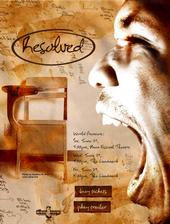
This is the opening of the movie Resolved. Up until this point it would seem obvious that debates should be easy to film. In national politics, they are often televised and have served as a way to document key parts of political history. But after jolting the viewer with the opening, the narrator explains that the highest level of high school policy debate started to take a turn in the 1960s to what is called “spread†(SPeed-READing). Spread involves speaking rapidly in order to get out as many arguments as possible. One debater started speaking faster and others just kept increasing their pace until nearly all debaters at the highest level were speaking at a rate of 300 to 400 words-per-minute. The speed at which the debaters speak does not make for comfortable observation. The film explains that since spread became the norm, only those who have participated in or coached debate can now effectively follow the debates.
Despite this potentially barrier, the filmmakers were still able to create a compelling film that is well balanced between explaining the competition that is debate and how the lives of the debaters affect their approach to the activity and its potentially exclusive nature. Â
The actual debates are more of an after-thought in much of the film while the true interest is four high school debaters who are followed over a two year period. Two, two-speaker debate teams are the focus of the documentary. The first team highlighted is the duo of Matt Andrews and Sam Iola of Highland Park High School in Texas. It is made clear from the beginning that Highland Park is a school of privilege with a history of success in all areas, academic as well as athletic. Highland Park is a place where the teachers and administrators declare “it is cool to be smartâ€. Sam Iola is the senior who, while excelling in debate, has all but given up on trying to achieve in the classroom. His obvious intelligence has not motivated him to try to apply himself beyond debate. Matt is Sam’s debate partner and only a sophomore. Because of his young age, he is called “the boy†by his fellow debaters and made to do all of the “grunt work†as his older team members try to teach him humility. Despite his lack of experience, Matt is shown to be an excellent debater for his age. Matt and Sam compete at the highest level of debate, traveling across the country, and end their season at what is considered the high school championship of debate, the Tournament of Champions.
Half way across the country a successful, but very different pair of debaters are the focus. Louis Blackwell and Richard Funches, juniors from inner-city, no frills, Jordan High School in Long Beach, California are the “other†team. Statistically, only 12 to 18% of their classmates at Jordan will go on to a four year college. Though they come from a high school that doesn’t have all the advantages, that doesn’t mean they are out of their league among top debaters. The film quickly establishes their debate accomplishments. This team is for real, but differences do exist. Richard works 14 to 24 hours a week at a grocery store where his managers speak highly of his work ethic. Debate and his work have kept him grounded, but he makes it clear that this wasn’t always the case. For him, debate is a way to “get outâ€. Without debate, Richard admits that he would be in “jail or dead. . . no lie.â€Â Louis seems less hardened, but does not want to get locked in to one view of himself. He explains that debate is one of many unique choices that sets him apart from expected behavior. While rap music may be the norm at his school, and his mother is shown pushing the beauty of 60s and 70s soul, Louis listens to “The Clash†and wears their t-shirts.Â
Their coach David Wiltz is often filmed in his car listening to rap music. He views his program as a way of “changing the gameâ€; both the game that is life and activity he choose to coach. He acknowledges that debate may have its flaws, but it allows the debaters to express themselves. It is a forum where people have to listen to the student’s views.Â
The film seems to reach its dramatic climax some 40 minutes in, with the end of each team’s season. Both teams achieve a positive result. Achievements are made at the competitive level. Thankfully for the viewer, after setting up the debaters and beginning to flesh out some themes, the filmmakers skillfully use the second half of the film to follow the debaters in greater detail for a second season. This leads to some dilemmas and some very unique twists.
The most important development is Louis and Richard’s decision to not to directly debate the topic of year (search and seizure), and instead, to focus on what they view as the more important issue . . . debate itself.
Using the Brazilian professor Paolo Friere as a basis for their position, Louis and Richard argue that debate, as a form of education, must move away from simply depositing information in the minds of students and emphasize arguments that are based on life experience and independent thought at the individual level. This argument, while not entirely new to policy debate, has an unsettling effect on many of the debaters and judges they encounter throughout the season. Participants are not used to confronting the arguments that Louis and Richard present. “Why can’t you just debate like you are supposed to?â€Â Louis and Richard are forced to confront why they debate, and whether they even belong in the activity. In the end, the authentic enthusiasm Louis and Richard present may make the viewer confront some of their own views of the way power structures affect their lives.
Back in Texas, Sam moves on to college, and Matt decides to move on to another school, Greenhill. For all the play the filmmakers give to Highland Park being elite, Greenhill is another cut above. As one of the top debate schools in the country, Greenhill provides full funding for the debate team to travel to tournaments nationwide. In the second half of the film Matt isn’t provided with the same detailed film coverage as the Jordan team, but his journey and ultimate results provide yet another compelling surprise that viewers should enjoy.
Overall, Resolved gives debate outsiders an eye-opening view of the activity and helps to explain a concept that is completely foreign to most people who have not participated in debate themselves. Resolved takes on difficult subject matter. But, by choosing interesting students to follow and by providing a view of debate that is true to all the participants, the film is a captivating journey that will be enjoyed.
—–
Resolved
Directed and Produced by Greg Whiteley
Color, 90 Minutes
One Potato Productions
Debuting on HBO June 16, 2008.
|
|
|
|
Comments:
P. Smith on June 19th, 2008 at 10:14 pm
Loved it. How may I purchase a copy? My students have to see this.
ram pandey on June 23rd, 2008 at 7:15 am
I,m also make a documentry and films but i have not to bary.i want to seal eo all my documentry.
Ian Jacoby on June 24th, 2008 at 10:52 pm
The film is available to buy in fall of 2008. As for the documentary itself, I thought it was fantastic. It really gives a ton of insight into debate and the competitiveness that exists. As a high school debater I’m ecstatic that we’re finally getting the recognition deserved.
joshd on July 2nd, 2008 at 8:52 am
Towson university won the college CEDA debate championships in May running a similar argument to the one Jordan uses in Resolved (a criteque of debate with a racial focus). It was very cool to see them win. That they beat University of Kansas (where I debated) in the final was the only negative.
David Thomas on October 30th, 2008 at 3:59 pm
As a retired director of intercollegiate forensics and author of debate books, I’ve seen several major innovations in the practice of debate in high school over four decades. The courage that Richard and Louis showed by challenging the reigning “SPREAD” paradigm through a passionate commitment to Paolo Friere’s Pedagogy of the Oppressed is by far the most important new thing to happen. As I see it, the primary value of the debate tournament system is to motivate students to master skills of analysis and advocacy through competition in an intellectual activity. As the film demonstrates clearly, the worst result of the spread technique is not so much that debates are made unintelligible to average listeners, but that it rewards mindless regurgitation of overwhelming volumes of evidence cards and argument briefs that the debaters themselves may or may not have had any part in producing. For a variety of reasons, the democratic purpose of having debates in the first place is subverted by the strong tendency to make it into a game that can only be played successfully by an elite, wealthy few schools.
Bravo to the breakthrough achievement of Louis and Richard, and their coach David Wiltz, who showed the way to open up the field to more diverse participants. Let us not overlook the great effect that the Urban Debate League has had in recent years in drawing in minority schools to debate competition. Yet it took Louis and Richard to show that it is not enough simply to recruit minority students into an elitist activity. Their living example of Pablo Friere’s educational philosophy, and their apt use of it to ground their entire arguimentative strategy, will ultimately revolutionize interscholastic and intercollegiate debate. Hopefully, the activity will become much more important to students than as a boot camp in preparation for laws schools, but a real liberalizing of public policy deliberation for everyone.
Finally, I want to say that as a film teacher, I’m very happy that the movie succeeds in portraying an esoteric activity like high level HS debate competition in realistic scenes, yet still manages to keep the narrative simple and clear enough to hold the interest of uninitiated viewers.
In other words, watch this movie, and you will probably enjoy it. Not only that, you’ll encourage your teenagers to try out for debate, and you’ll actually enjoy attending their contests when they do.
Norman on February 16th, 2009 at 6:10 pm
How do I purchase for download for my students?
Matthew on November 11th, 2009 at 6:41 pm
Sad and touching, yet strangely motivational. Makes me not to want to lose another round.
Lesly Gutierrez on January 6th, 2010 at 4:44 pm
This movie was amazing, I’m a high school debater and we watched this one day and I think it’s so cool to see debate shine, and Richard and Louis’s style of debate was really cool.
Trendi Adams on March 14th, 2010 at 1:29 am
Interesting to read the comments from current high school debaters! Though Richard and Louis’s style appears to be “really cool”, it is a harsh and real reality that where is the importance of the debate when no real debate occurs, and the harsh reality of the stigma attached to African American debaters. As a current coach and being in the forensic world since the age of 9 and being a 30 year old black female, the elitism of the art is blindly exclusionary, however, on the other level of it, the prime purpose of the debate itself can be had if in CEDA or CX {whatever region you’re in} the defragmenting of “SPREADING” can occur and educational benefits can begin. However, this is not the only style of debate in high school or college.
This film has impacted me both positively and negatively, however, due to my personal experience in this world has been so long and am still active, the most powerful part of this film to me is the nonverbals of the film and what wasn’t said.
Policy Maker on April 30th, 2013 at 5:01 pm
Currently being a middle-class policy debater, I obviously have a bias. This was a great film, for sure, but I completely disagree with the approach of the Long Beach team. If I lost to their arguments on how the existing style of debate is not providing us with the best education, I’d feel so screwed over.
“At the end of the debate round I think it’s probably a good idea to incorporate under evidence of minorities in the debate community and so I vote affirmative”.
That judge made me so angry. From what I could tell in the round, the negative team was clearly winning, and they weren’t arguing that whoever has the most evidence is who should win the round, they were arguing that modern debate is about theoretical ideas, and shouldn’t be based on personal connection, as the affirmative team had suggested. As one boy had stated, they were a team of two white males, there’s no possible way they could connect to their arguments.
The biggest problem was pointed out by the last judge that spoke. The Long Beach team was arguing that the current structure/style does not offer the best education, and puts far too much emphasis on winning, then they proceeded to blatantly state that they should win because their idea is better for reasons a, b, and c which are in fact voting issues, (voting issues being part of the thing they said they were concerned with because they diminish the connection between the debater and their arguments.)
Another thing that bothered me is that the judges were talking about how impressive it is that the Long Beach team had spoken without evidence and made logical explanations of their ideas. This is an unfair assessment, because Louis and Richard are saying the same things every round. No matter affirmative or negative, they just say that they want to change the way people debate. It would be easy to go up and give a speech with no notes or evidence if that’s all you’ve been saying the whole season.
It’s also unfair to the opposing teams. They spent days, weeks, or months researching the resolution, collecting evidence, competing in practice rounds, and doing whatever they could to prepare them for the tournaments ahead. They do not, however, have any preparation for the arguments made by Richard and Louis. The Long Beach team has their non-traditional arguments already planned out. They spend their time practicing the use of the same persuasive words over and over again, until it becomes second nature. And, because raw persuasion and personal connections with arguments is not the purpose of policy debate, traditional teams do not practice it. This makes it unfair for teams opposing Richard and Louis to present adequate arguments. I mean what can they even say? They put together a case, prepared negative files, extensions, and all of the other necessary arguments, and the Long Beach team just tells them they aren’t debating the right way. They don’t attack the affirmative’s case at all, and they never provide an actual plan to resolve the year’s issue. These opposing teams just have to freestyle, given no preparation in advance for the kind of arguments Richard and Louis are presenting.
Lastly, just the fact that they were trying to change debate upset me. Obviously people like it, that’s why it’s become as popular as it has. They were making bigoted arguments. The fact that they might not have the money or the time to prepare is not an argument that should be made in policy. It’s simply not the point. As the boy in the elimination round brought up, if they don’t have time or money to amass large quantities of evidence, then why are they competing in policy debate? They could easily try LD or Pufo, because those types put less stress on evidence, and more on principles, values, and real life situations.
I’m totally disappointed that so many of the judges failed to overlook these things. It shows how subjective the activity is. Nonetheless, I will continue my new age, spreading, policy ways, in contrast to the Long Beach boys approach.
|
|





